Home
  • Request Info
  • Visit
  • Apply
  • Give

The Future of AI: What Computer Science Students Need to Know

Breadcrumb

  1. Home
  2. The Future of AI: What Computer Science Students Need to Know

The Future of AI: What Computer Science Students Need to Know

Artificial intelligence, algorithms, and other emerging technologies aren’t merely buzzwords — they’re academic disciplines and areas of research and innovation that are reshaping how we work, create, and engage with the world around us.

Informed by insights from Dr. Stephany Coffman-Wolph, a computer science (CS) professor at Ohio Northern University (ONU), this guide explores what CS students need to know about the latest trends in AI and the necessary skills to build for long-term success.

  • More about Dr. Coffman-Wolph
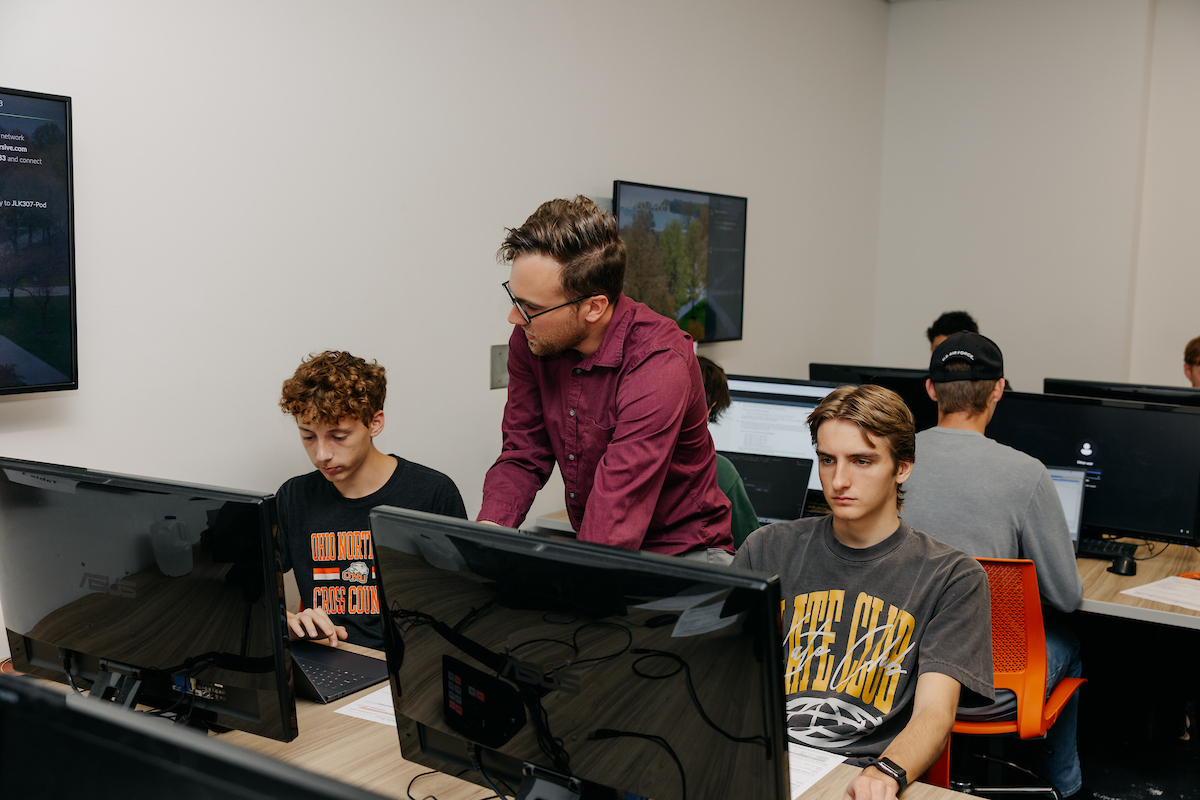
professor teaching students

What Is Artificial Intelligence? (According to a Computer Scientist)

Tracing back to the 1950s, Artificial Intelligence (AI) began with a singular question posed by researchers like Alan Turing: "Can computers think?”

As Dr. Coffman-Wolph explains, the core motivator behind AI was the question, “How can I use a computer to mimic a human to the point where I can't distinguish between a human and a computer?” It is intended to capture the creativity and intellect of human beings.

What Are the Different Branches of AI?


Over the last 70 years, AI has drastically evolved, diverging into multiple areas of study and applications, including fields like:
●    Computer vision: to aid computers in “seeing” and understanding images and videos
●    Deep learning: to analyze massive datasets to identify intricate patterns
●    Expert systems: to reproduce human decision-making processes
●    Generative AI: to create content, images, video, code, and more
●    Machine learning: to enable computers to learn from data
●    Natural language processing: to empower computers to understand and make sense of human language


Along with these, many other disciplines within the realm of AI continue to grow and branch off, thanks to the hard work and research of computer scientists who ask bold questions, test new ideas, and generate new, innovative solutions.
 

Trends in Computer Science and AI

  • As innovations in AI continue to gain momentum and become more integrated into daily life, the focus isn’t only on what these tools can do — it’s on how we use them well.

    According to Dr. Stephany Coffman-Wolph, “We’ve created a whole bunch of amazing tools that are really changing the landscape.” Now, the work of computer scientists centers on embracing these tools by refining and integrating them. That means asking strategic questions:
    ●    How do we make AI systems more reliable?
    ●    How do we integrate them responsibly into real-world applications?
    ●    How do we design systems that strengthen human expertise?

    While innovation moves in waves, today’s rapid expansion requires developers who understand more than surface-level functionality. It demands a strong foundation in machine learning, programming languages, abstraction, algorithms, and software engineering best practices.

    At ONU, that rigorous preparation ensures you’ve honed a diverse technical skill set that empowers you to evaluate, improve, and engineer systems that have lasting power and promote problem-solving. 

  • While we may have more access to cutting-edge technology — like AI — than ever before, developers still need foundational knowledge in data structures, programming languages, algorithms, and other disciplines to evaluate and optimize the output of AI tools.


    Coffman-Wolph witnesses this reality in her classroom and through the real-world experiences of ONU students. One student recently returned from a software internship and shared that their team used AI to auto-generate unit tests because “nobody really likes doing it.”


    The core lesson is this: AI can serve as a tool, helping computer scientists work more efficiently, but it’s not a substitute for technical skill. Hard-earned human expertise is needed to refine outputs, catch errors, and ensure overall quality. 
     

    “It gives you a framework,” Coffman-Wolph emphasizes. ”And then you can replicate it and use that to do a better job. Sometimes it may even suggest things you forgot to test. You still have to understand what it’s doing, why it’s doing it, and how to actually do the [task].”


    Artificial intelligence is not a replacement for professionals, but rather a guardrail that guides their work, saves time, and helps them focus on more meaningful or complex projects. 

  • Since its beginnings, artificial intelligence has always borrowed ideas from other disciplines. 
     

    “AI is inspired by fields like biology,” Coffman-Wolph explains. “There’s a whole category of algorithms — like ant colony optimization — where researchers study how ants interact or how birds move in flocks, and then mimic those patterns in the computer realm.”
     

    This interdisciplinary foundation continues to shape the evolution and applications of AI. At ONU, the integration comes naturally. Coffman-Wolph regularly works with students who pair a CS degree and AI knowledge with:


    ●    Business and data analytics: Computer science majors combine technical expertise, such as machine learning, with data analytics to support informed decision-making, process optimization, and predictive modeling.

    ●    Physics and applied mathematics: These students utilize computer science to take on large-scale computations, advanced simulations, and complex models — including work related to emerging areas such as quantum computing.

    ●    Art and graphic design: Since ONU also offers a computer science minor, graphic design majors often enroll in CS classes. Coffman-Wolph shares that these design-minded students are especially fun to work with in software development or mobile app classes. They bring an artistic perspective to the user interface — from thoughtful color schemes and button placement to creating designs that feel intuitive, accessible, and cohesive.

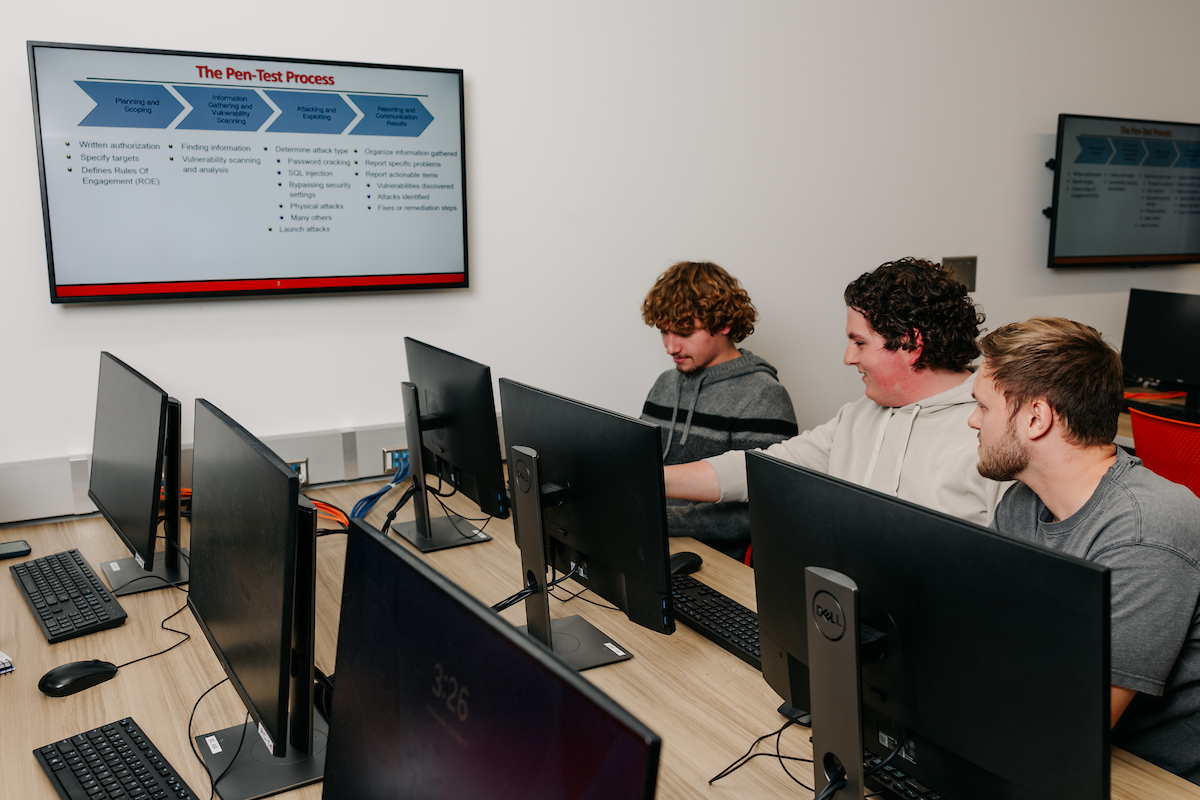
Students working on a class project

Computer Science + X

Reflecting the interdisciplinary nature of modern AI, ONU recently launched the Computer Science + X (CS+X) program, which empowers students to connect their excitement for programming and problem-solving with another major to diversify their expertise and expand their career possibilities.
Learn more about Computer Science + X


“Garbage In, Garbage Out”: The Growing Demand for Good Prompt Engineering


Prompt engineering is the practice of crafting and optimizing the instructions we give to AI tools to create reliable and useful outputs. It’s a skill developed over time and can drastically shape how we interact with artificial intelligence and integrate it into our work and daily lives.
Coffman-Wolph emphasizes that prompt engineering relies on the same principles of human-centered communication — precise language, clear directions, and plenty of context.


“You can’t just say, ‘Create me a thing.’ It doesn’t work that way. We’re going to have to teach students prompt engineering, an emerging skill focused on how to interact with AI to get the help you actually need. It’s the classic ‘garbage in, garbage out’ problem we’ve always had in computer science: If you don’t prompt well, you won’t get good results.”
 

At ONU, we incorporate a technical writing course into our computer science curriculum to ensure our students refine their writing competencies and gain extensive experience.


What Skills Do Computer Science Students Need?

  • To chart a steady career path and stay adaptable in a rapidly changing landscape, computer science students must become proficient in core concepts and technical skills, including:

    ●    Programming languages: Students should develop fluency in multiple programming languages, learning how to design, build, test, and maintain software systems.
    ●    Algorithms and data structures: A strong theoretical foundation enables students to understand how and why technical solutions work.
    ●    Systems, architecture, and low-level computing: Understanding how software interacts with hardware and operating systems empowers students to optimize performance, security, and scalability.
    ●    Machine learning (ML): Students benefit from a solid grasp of machine learning due to its broad applications in data analysis, pattern recognition, and predictive modeling.

    The computer science major at ONU offers a rigorous, hands-on approach that ensures students develop strong technical competencies while also fostering curiosity and creativity. From digital logic to computer architecture, the CS curriculum builds both breadth and depth of knowledge, along with the agility needed to excel in a fast-moving field.

  • While a robust technical knowledge  is critical to building a thriving future, computer science majors’ success also depends on well-practiced soft skills, such as:


    ●    Presentation standards: Like most professionals, software developers must learn how to capture others’ attention, convey their ideas with clarity, and effectively connect with their audience. 
    “It’s about your presence. If people can’t see you or engage with you, they’re not going to connect with your ideas.” Coffman-Wolph emphasizes, “Knowing how to interact, how to present, and how to engage others plays a much bigger role than many people realize.”


    ●    Teamwork: Innovation stems from collaboration. Computer scientists work in teams early in their education and throughout their careers, learning to compromise and solve problems together. These experiences help them understand what stakeholders, clients, and users actually want, stay accountable, and deliver effective solutions.

    ●    User-centered thinking: Successful AI and software tools are human-centered, revolving around how people think, feel, and behave. This means considering psychology, usability, accessibility, and technical performance in connection with one another. Fields like game development and app design are heavily dependent on human motivation, so understanding what drives someone to download a tool, continue using it, or trust it is essential to applying technical skills well.


    These skills, and many more, are woven into ONU’s academic approach. Here, students dive into collaborative learning experiences, extracurricular activities like our competition teams, and real-world internships and co-ops — all designed to prepare them to work effectively with people, not just technology.
     

How Can Students Prepare for a Future in Artificial Intelligence?

If you’re considering pursuing a computer science degree or want to learn more about AI’s limitless possibilities, Coffman-Wolph offers some practical advice to inspire your discovery.

“Dip your toe into programming,” she advises. If you’re new to computer science, begin by exploring online videos or microcredentials in languages like Python, which is the “major programming language being used in artificial intelligence right now,” Coffman-Wolph notes. This can help you determine whether programming sparks your interest before you fully commit to a degree.

Next, start playing with AI tools. One of the best ways to learn is through experimentation. Try working with AI tools and explore their capabilities. There’s no risk in prompting them poorly. You’ll simply get unexpected or “weird, garbled” results. That trial-and-error process is part of understanding how AI works and how to interact with it effectively.

Campus Walk Beauty Shot

Your Future Starts at ONU. Kick-Start Your Computer Science Education Today

Excited about the opportunities that computer science and AI have to offer? Ohio Northern University provides a range of interdisciplinary pathways to gaining robust computer science skills.

Whether you choose to earn a BS in Computer Science, enroll in the CS + X program, or add a computer science minor, you embark on a transformative educational journey built on faculty mentorship, interdisciplinary learning, and real-world experiences.

Whatever your aspirations, an ONU degree can help you get there. Discover the possibilities that await.
  • Apply to Ohio Northern University.
Learn more about life as a Polar Bear:
  • instagram
  • facebook
  • Tiktok
  • youtube
  • twitter/x
  • twitter/x
  • LinkedIn
image of campus - decorative only

Ohio Northern University

525 South Main Street Ada, OH 45810
419-772-2000

MB: Footer: Middle 1

  • Libraries
  • ONU Gear Shop
  • Freed Center
  • Career Services
  • ONU HealthWise Pharmacy
  • Campus Map
  • University Licensing & Trademarks

MB: Footer: Middle 2

  • Employment
  • Bookstore
  • Registrar
  • The Inn
  • Calendar
  • Faculty/Staff Directory

Footer Menu

  • Events
  • News
  • Mission & Vision
  • Contact
  • Privacy Policy
  • Consumer Info
  • USDA Statement
  • Media Inquiry

Information for:

  • my.onu.edu
  • Alumni/Friends
  • Parents/Families
  • Faculty/Staff Directory
  • Center for Corporate Engagement
  • Request Info
  • Visit
  • Apply
  • Give
  • About
    • Quick Facts
    • President and Leadership
    • Trustees
    • Financial Affairs
    • University Advancement
    • Recognition of Excellence
    • Getting to Know Ada
    • Commencement
    • Controller and Bursar
    • Human Resources
    • Campus Sustainability
    • History and Tradition
  • Academics
    • Programs of Study
    • Academic Affairs
      • Honors Day
    • College of Arts & Sciences
    • College of Business
    • College of Engineering
    • College of Law
    • College of Pharmacy
    • Institute for Civics and Public Policy
    • Camps, Conferences, Workshops and Community Events
    • Registrar
    • Heterick Library
    • Taggart Library
  • Admissions & Aid
    • Apply
    • Accepted Students
      • time to celebrate
    • Visit
    • Financial Aid
    • Undergraduate
    • Pharmacy
    • Transfer
    • Graduate
    • International–Degree and Exchange
    • College Credit Plus
    • Virtual Tour Map
  • Student Life
    • Housing
    • Dining
    • Center for Student Success
    • Polar Careers
    • Health and Wellness
    • Public Safety
  • Distinctly ONU
  • Athletics