Sustainability on Campus
Ohio Northern University's commitment to a sustainable future is evident in the numerous energy projects implemented across campus in recent years, with even more "green" updates on the horizon.ENERGY CONSERVATION
• ONU’s fleet of hybrid and electric campus vehicles reduces the University’s dependence on fossil fuels. Additionally, the University recently purchased its first electric, zero-turn lawn mower and has plans to convert all campus grounds equipment–from utility vehicles to lawn mowers to leaf flowers– from gasoline/diesel to electric.
• ONU converted all exterior lighting as well as the interior lighting in several major buildings from halogen and incandescent to energy efficient LED lighting. In total, 10,162 lighting fixtures were retrofitted.
• Working with PlugSmart, an Ameresco company, ONU installed an automation and control system in approximately 90 percent of campus buildings in order to remotely control and monitor energy utilization in each building. The system alerts ONU to energy spikes caused by equipment failure, and allows staff to remotely adjust HVAC and heating levels to reduce energy usage during academic breaks.
• The Lehr Kennedy Engineering Building is a Silver LEED (Leadership in Energy and Environmental Design) certified building.
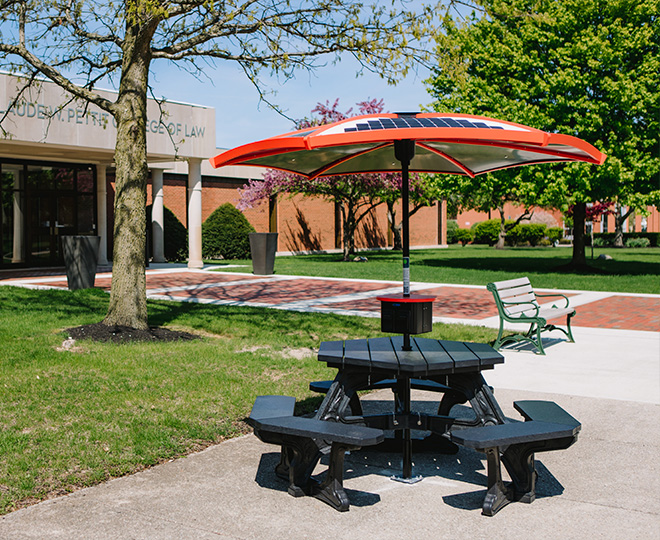
Four solar-powered picnic tables
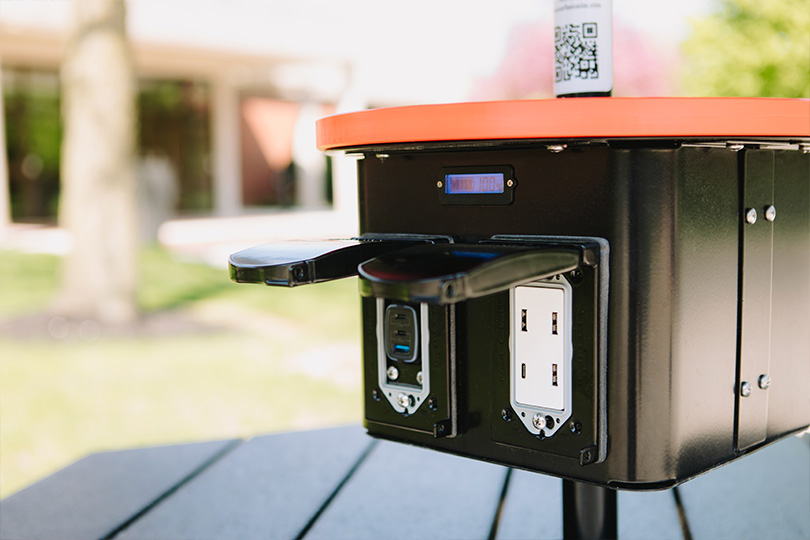
These tables on campus have LED panels on the picnic tables’ umbrellas that capture the sun’s energy and power USB ports that can charge laptops, cell phones and tablets.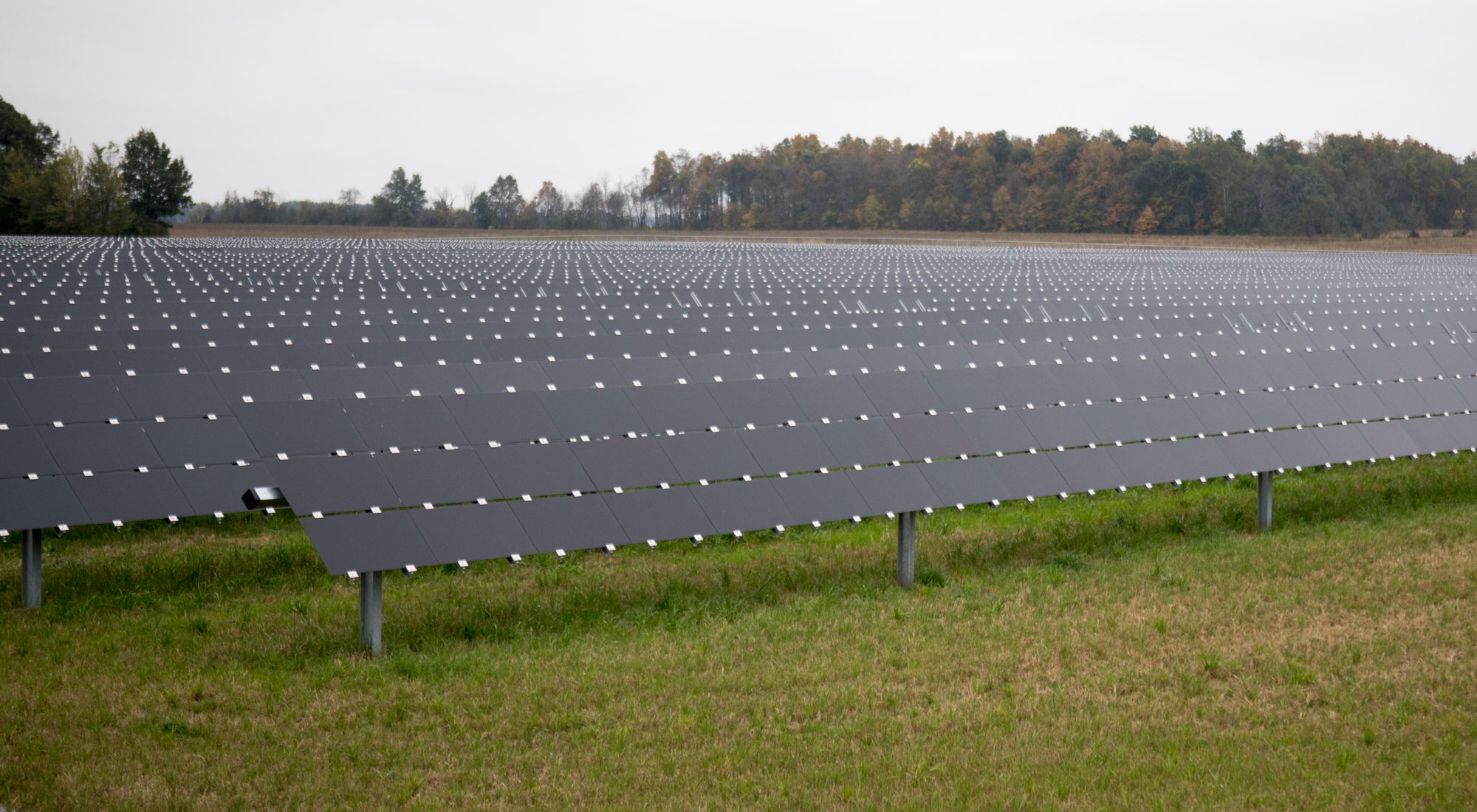
Solar Field Agreement
Ohio Northern has a 25-year contract with AEP Energy for a 3 megawatt (annually) solar field on 11 acres of University property located southwest of campus on Klinger Road. The agreement allows for 18,000 panels, a surrounding chain link fence covered in greenery and a perimeter tree line. Ohio Northern provided the property and AEP provided the funding of the entire project. AEP Energy also provides all mechanical and ground maintenance of the property.For the Bees
The grassy area surrounding the retention basin on the south side of campus between the president’s home and Stadium View Apartments is home to a colony of bees. This prairie area features natural vegetation (i.e., 100 small flowering trees, shrubs and wildflowers) that provides a perfect habitat for 10 beehives. Seeding this former grassy space eliminates the need for mowing, thereby reducing the University’s use of gasoline and polluting lawn mowers.

Tree Campus USA
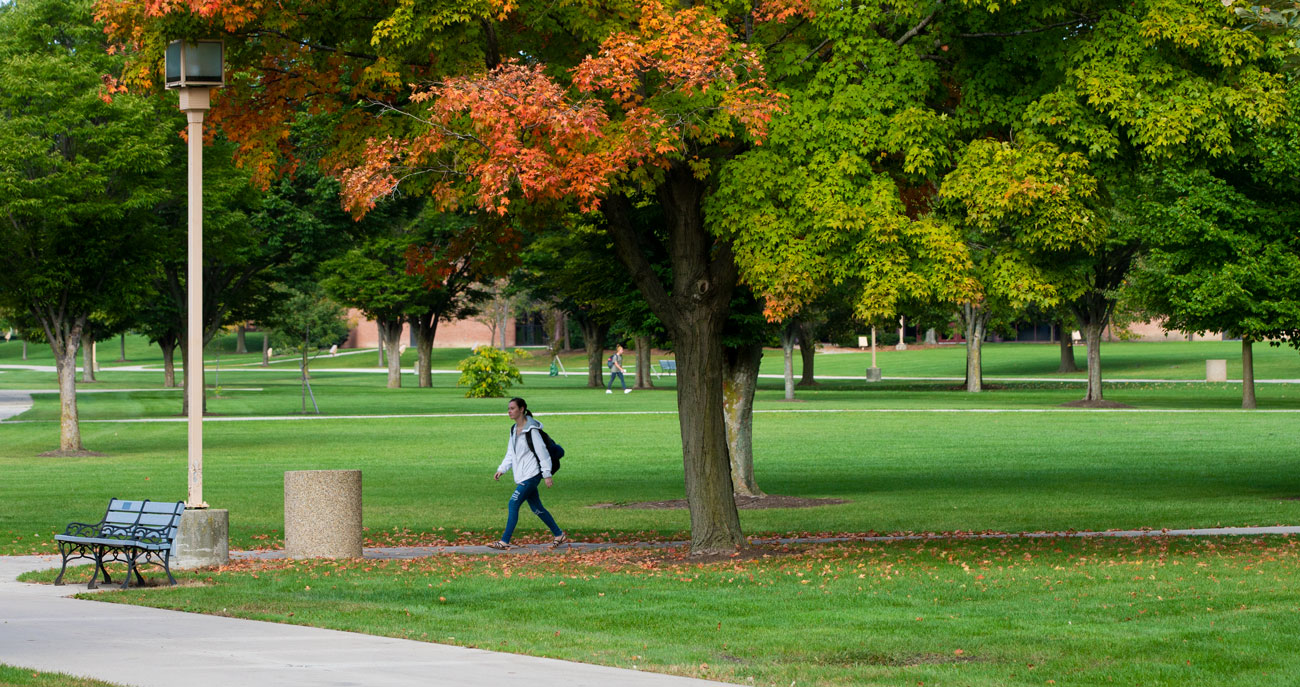
Since 2009, Ohio Northern University has been recognized as a Tree Campus USA by the nonprofit Arbor Day Foundation. Tree Campus USA, a national program launched in 2008 by the Arbor Day Foundation and Toyota, honors colleges and universities and their leaders for promoting healthy trees and engaging students and staff in the spirit of conservation. To obtain this distinction, Ohio Northern University met the five core standards for effective campus forest management: a tree advisory committee, a campus tree-care plan, dedicated annual expenditures for its campus tree program, an Arbor Day observance, and student service-learning projects.

Electric Vehicle (EV) Charging Stations
ONU has eight electric vehicle (EV) charging stations on campus. The stations are 220-volt, Level 2 ChargePoints. Two are located at the Dicke College of Business Administration; two at the King-Horn Sports Center; one at the Raabe College of Pharmacy; and one at The Inn. ONU charges $1 per hour for the first four charging hours and $4 each additional hour. The location of the stations can be found on the campus map.
Recycling Efforts
The past few years have seen the reduction of “landfill” dumpsters and an increase of recyclable dumpsters on campus. In fact, the University’s landfill waste has been cut in half. Although these efforts have not led to any cost savings, they have reduced the number of trash hauls and we’re doing something that we know is good. In conjunction with Allied Waste Haulers, Ohio Northern is funding a recycling program at Ada Schools. A recycling dumpster has been placed on the Ada Schools campus.

Sustainable Dining
ONU Dining Services promotes a number of sustainability initiatives, including these programs: “Green Container, Green Planet” program, “Skip the Straw”, use of BPA-free recyclable tumblers, trayless operations, as well as celebration of WasteLESS Week and Earth Day events.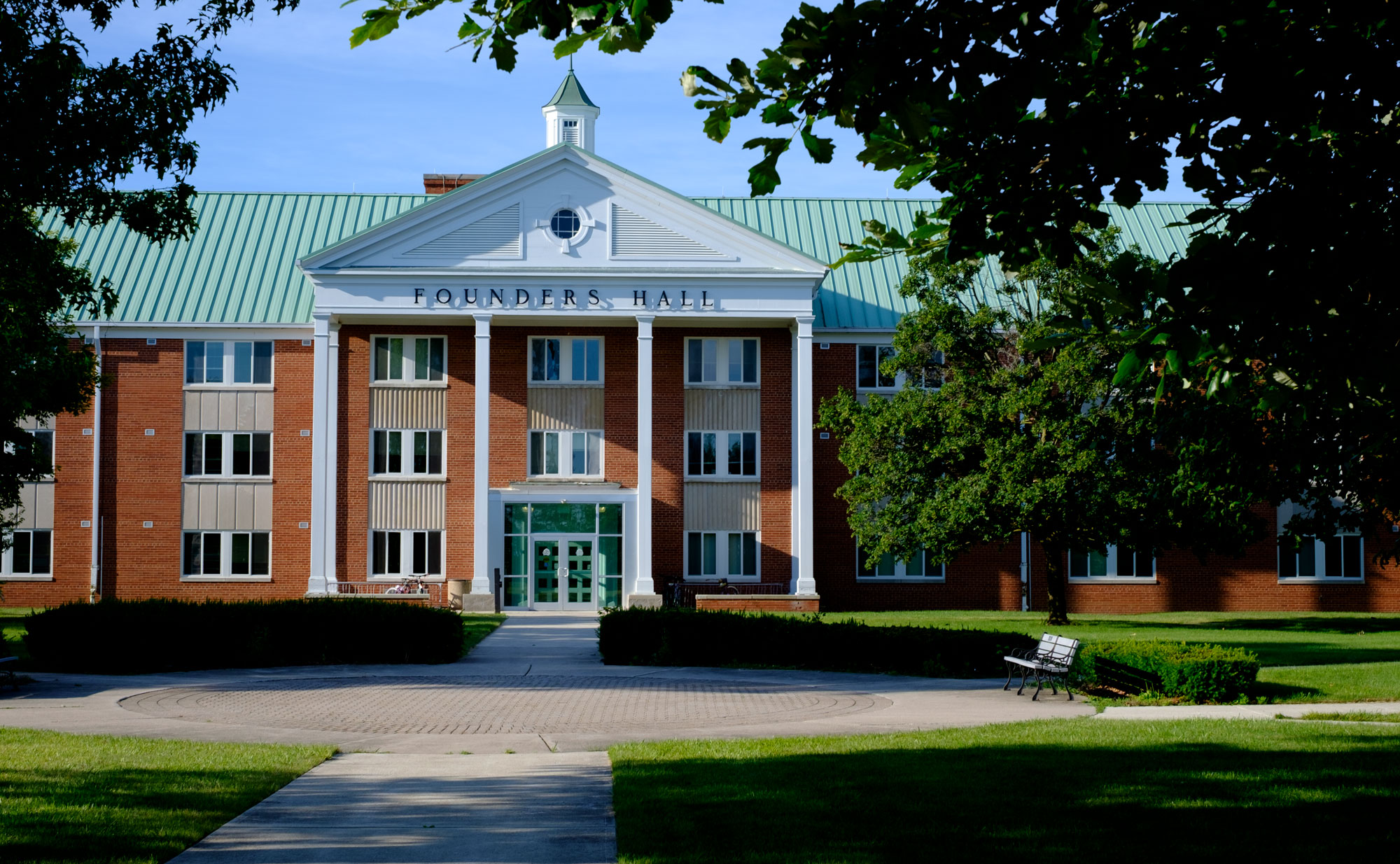
Geothermal Heating
Founders Complex and Affinity Village Complex feature a geothermal heating and cooling system to reduce energy use and water consumption.Academic Programs
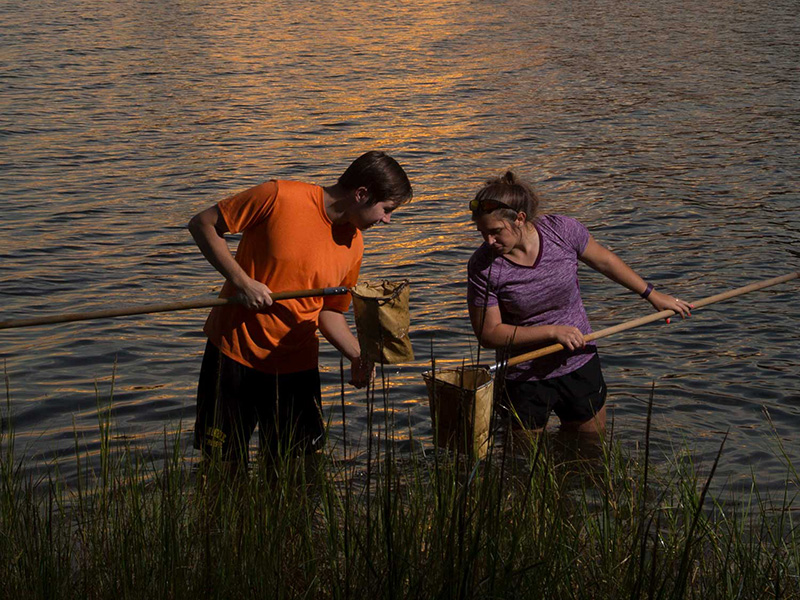
Are you interested in majoring in an environmental field of study? A knowledge of environmental issues from several disciplinary perspectives, using methods from the social sciences, the natural sciences and the humanities are available to you.
-
The Ohio Northern advanced energy concentration is open to electrical, mechanical and computer engineering students. The concentration builds on a foundation of strong fundamentals coupled with current energy topics and issues.
The advanced energy concentration curriculum consists of core discipline specific courses and energy-relevant required and electives courses. Energy-relevant courses are both within the chosen discipline and from the other engineering disciplines. This cross-discipline, energy-focused approach prepares students for the integrated concepts prevalent within advanced energy technologies.
-
The environmental and field biology major connects key concepts from many disciplines in an environmental context, providing a framework for the study of ecosystems and human interaction with the Earth. Environmental challenges face every business, agency and institution – from the decision of whether to recycle junk mail at the smallest two-person office, to the decision of how to cost-effectively comply with complex environmental regulations in big industry. Part of the idea of majoring in environmental studies is to be better prepared for a wide array of challenges.
Students who studied in this area are pursuing careers with industrial firms, consulting firms and governmental agencies. Students liked the idea of an interdisciplinary program that drew concepts from several different fields. Environmental issues are found in all kinds of fields, from geology and biology to public policy and law.
-
The Ohio Northern environmental engineering concentration is open to civil engineering students. The concentration builds on a foundation of strong fundamentals coupled with current environmental topics and issues.
As an environmental engineer, your focus on protecting our earth drives you to design systems that meet society’s needs today without compromising tomorrow. Equipped with hands-on experience, technical expertise, and a drive to improve sustainability, you can pursue roles in consulting firms, government agencies, and private industry — designing systems that protect our planet and enhance our communities.
-
The Ohio Northern sustainable engineering concentration is open to mechanical engineering students. The concentration builds on a foundation of strong fundamentals coupled with current sustainability topics and issues.
A concentration in sustainable engineering ensures students develop the technical foundation to design efficient, reliable systems and products with people and the planet in mind. This balanced approach helps students discover solutions that reduce environmental impact, improve energy use, and advance sustainable innovation.
Frequently Asked Questions
-
ONU utilizes renewable energy through a 25-year contract with AEP Energy for an 11-acre, 3-megawatt solar field located near campus. The university also features four solar-powered picnic tables with LED panels and USB charging ports, allowing students to charge devices using solar power while studying outside.
-
ONU Dining Services operates several eco-conscious programs, including:
- "Green Container, Green Planet" reusable carryout container program.
- Trayless dining operations to minimize food waste and conserve water.
- "Skip the Straw" campaigns and BPA-free recyclable tumblers.
- Annual campus events like WasteLESS Week and Earth Day celebrations.
-
ONU has cut its landfill waste in half in recent years by expanding recycling access across campus and reducing landfill dumpsters. Additionally, ONU partners with Allied Waste Haulers to fund recycling programs for local Ada public schools.
-
Over 90% of campus buildings use automated building management systems to monitor energy spikes and optimize HVAC settings during academic breaks. Campus facilities incorporate geothermal heating and cooling (such as in Founders Complex and Affinity Village), and the Lehr Kennedy Engineering Building holds Silver LEED certification.
-
Yes! ONU features eight 220-volt Level 2 ChargePoint EV charging stations across campus, located near key venues like the Dicke College of Business Administration and King-Horn Sports Center. The university fleet also utilizes hybrid/electric vehicles and electric grounds equipment to reduce fossil fuel emissions.
-
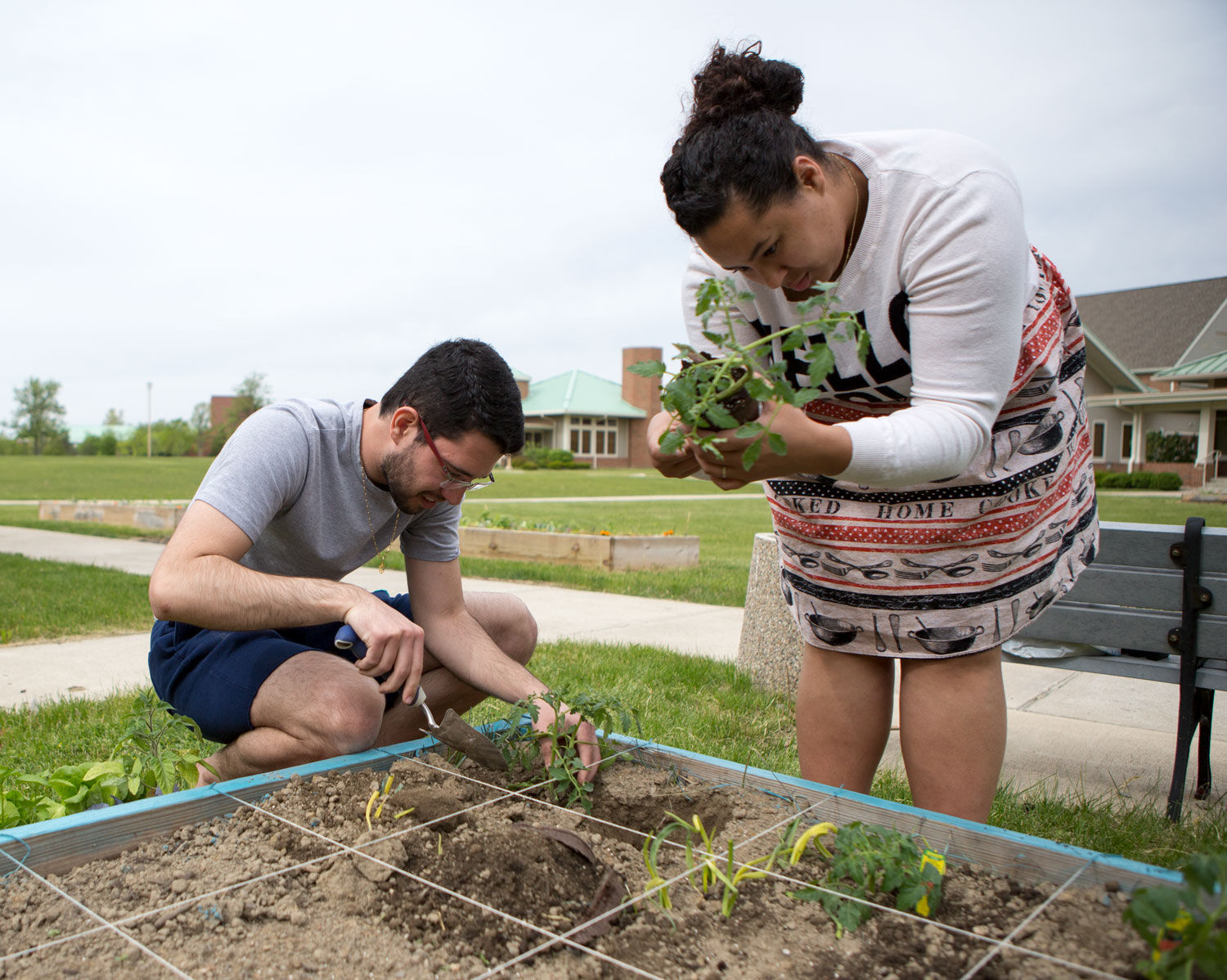
Students can participate through campus organizations, residence hall initiatives, and hands-on community projects like the Affinity Gardens. This student-managed garden grows fresh, organic produce in raised beds to support local food banks like the Ada Food Pantry.