
For many undergraduate science students, the opportunity to work in a laboratory on real-life research feels out of reach. At large universities, the intense competition often makes landing a spot in a faculty lab slim, and at other institutions, dedicated research programs for undergraduates simply don’t exist.
Fortunately, that’s not the case at Ohio Northern University.
A trademark of an ONU education is ample opportunities for high-impact learning, and the ONU chemistry program is no exception. It’s no coincidence that student research is a regular cadence of the chemistry program; in fact, it’s by design.
In the fall of their sophomore year, chemistry majors take their first capstone course. “During that course, all the faculty come in and present what kind of research they’re working on. So when it comes time for registration, students can ask faculty, ‘Do you have a spot in your lab? Can I come work with you?’” explained Dr. Chris Spiese, professor of chemistry.
There is no rigorous selection process or even an application to submit; all a student has to do to get involved is simply state their interest in a research project. Spiese and his colleagues are more than happy to bring them on board.
Mentorship in action
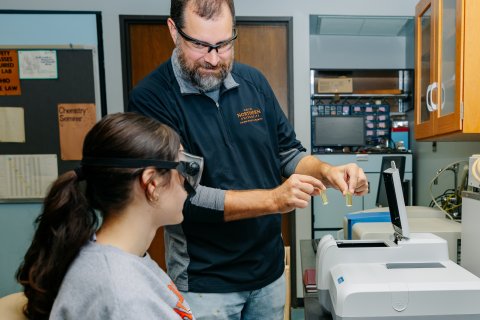
Currently, Spiese is overseeing three students—Emily Pacek, Jeremy Kosir and Marissa Shoemaker—who are working on research projects in his lab. Each project is distinctly unique and requires learning a variety of analytical techniques.
Through early exposure to working in the lab, students not only become familiar with the fundamentals of real-world scientific research, they also learn how to use different kinds of lab instruments to gather data.
“Typically, what will happen is the student will find themselves on one main technique but then have to supplement with other complementary techniques,” says Spiese. “It’s a lot of using what they have and taking it to the next step or figuring out how to get the information we want and need.”
Upgrading the experience with new tools
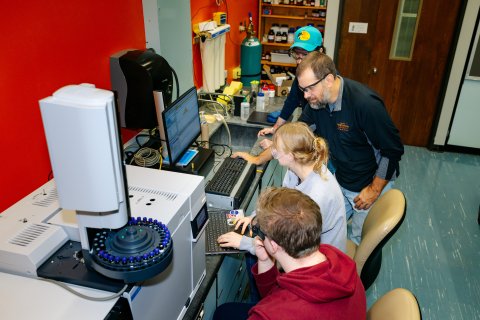
The program’s research capabilities recently expanded with the acquisition of new lab instruments, including an ultraviolet invisible spectrometer, gas chromatograph mass spectrometer (GC-MS) and a microwave plasma atomic emissions spectrometer (MP-AES).
Spiese is energized by the new possibilities. For example, he is utilizing the new GC-MS to run gunshot residue swabs – a potential method to identify criminals. In addition, the MP-AES is a brand-new capability for ONU. In the near future, it will be used to study metal from meteorites and a collaborative research project on lead in soils.
“These instruments not only replace aging instruments,” Spiese says, “they give us different perspectives and new capabilities.”
Preparing for what’s next
At the conclusion of their research project, students walk away with more than just credits on their transcript or entries on their resume; they move forward with valuable experience that they can build on for a lifetime.
“For me, the most rewarding part is always seeing the students succeed in their next endeavor,” says Spiese. “Not only do I have these students who essentially got their start here, but a lot of them rely on me for a recommendation. When that happens, I know that they’re going to go on and do something really cool.”