
Jazz is rooted in creative self-expression. It’s a philosophy that mirrors the life and career of Ohio Northern University music professor and trumpeter David Kosmyna, D.M.A. A versatile musician, educator, and conductor, Kosmyna lives on his own terms, dedicated to spreading the joy of the genre he loves.
“I’ve always played jazz,” he says. “I almost had to do it; the music kind of called me.”
This spring semester, Kosmyna is taking that calling on the road. On sabbatical as a jazz ambassador of sorts, he’s performing at jazz festivals across the country, guest lecturing at the University of Michigan, and conducting a new youth jazz ensemble for Toledo Live Arts.
His mission is clear: to keep the music and legacy of greats like Louis Armstrong, Duke Ellington, and Jelly Roll Morton alive. After all, jazz is America’s greatest gift to the world, he says. It’s the root from which everything from rock ‘n’ roll to country grew.
Called to the trumpet
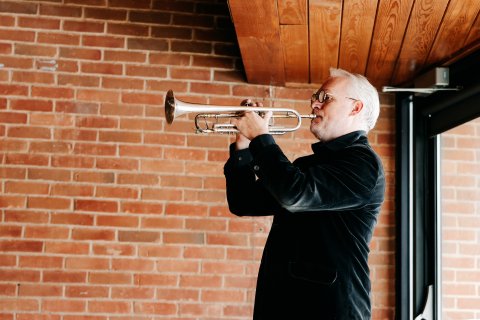
Kosmyna’s passion for jazz began at an early age, fueled by listening to Louis Armstrong’s “Hello Dolly” recording on his Sony Walkman and to his grandpa’s eclectic collection of jazz records.
When he started playing trumpet at age 10, the instrument captured his imagination and never let go.
“I considered becoming a cartoonist, an attorney, and an architect,” he laughs, “but each time, the trumpet kept calling me back.”
While his formal degrees focused on the classical canon, he maintained his devotion to early jazz. This dual path turned him into a versatile trumpeter who can play in a professional symphony one evening and lead a hot jazz ensemble the next.
Beyond the classroom, he is a staple in the regional scene, frequently performing with the Kerrytown Stompers (Ann Arbor), the Toledo Jazz Orchestra, and the Toledo and Lima Symphonies.
Learning the language
For Kosmyna, the key to musical growth is immersion.
“If you want to learn to speak French fluently, you go to France for a few months. It’s the same with music, you have to surround yourself with it.”
He notes that his teaching improved when he stopped talking and started making his students listen.
“Every great recording is like a three-and-a-half minute music lesson,” he said. He teaches that while playing what’s on the page is technically correct, the true soul of the music lies in its infinite interpretations.
Like any language, he believes students must learn to “speak” music before they can “read” music. He often quotes trumpeter Clark Terry of the Count Basie Band: “First imitate, then assimilate, then innovate.” This progression is the foundation for improvisation, which is key to jazz.
“Conversation is improvised, and we are able to do that because we understand the modules of communication in our shared language,” he explained. The same is true for music, he adds.
He views improvisation as a thrilling, lifelong journey.
“It’s maddeningly frustrating because it’s never ‘good enough,’ but the journey is the point,” he said. “I tell my students to just keep doing it.”
The art of the diagnosis
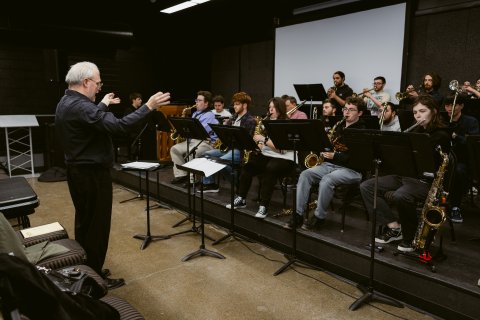
At ONU, Kosmyna’s impact extends beyond the stage. He mentors music and non-music majors, teaches courses in composition, music theory, and brass pedagogy, and directs ONU’s jazz and brass ensembles.
Teaching, he says, is a process of decoding, solving problems, and making connections. If a student is struggling, he seeks to understand the root cause, be it music literacy, physiological, psychological, or some combination.
“It’s like being a physician,” he explains. “You diagnose the problem, prescribe a treatment, and monitor the treatment.”
Whether he’s in a private lesson or on the conductor’s podium, his goal remains the same: “I want students to enjoy what they’re doing, to find value in it, and to be thrilled by the experience,” he said.
Spring plans
Kosmyna’s reputation as an educator recently earned him the directorship of a new Toledo Live Arts jazz ensemble composed of Northwest Ohio’s premier high school musicians.
For Kosymna, who once considered becoming a high school band director, it’s an exciting opportunity.
“I feel strongly about education at this age level,” he said. “I’m looking forward to the challenge.”
While he mentors these young players, his sabbatical will also take him to the national stage, with performances at jazz festivals across the country, including in Monterey, California, the French Quarter in New Orleans, Davenport, Iowa, and North Carolina.
Through it all, the lectures, performances, and directing, he counts himself lucky to be able to connect more people to an art form that defined his life.
“Jazz is my absolute passion,” he says.