
Most travelers take the clean, wrapped paper cup in their hotel room for granted. But for manufacturers, getting that single cup from a bulk sleeve into its own hygienic wrapper is a logistical puzzle.
To solve it, a group of Ohio Northern University students from the T.J. Smull College of Engineering is partnering with Graphic Packaging International (GPI). For their senior capstone project, the team is rethinking the process of preparing these everyday items for a global market.
GPI is a Fortune 500 company specializing in innovative, sustainable packaging products for food service, health care, hospitality, and other venues. While they have more than 100 locations worldwide, the capstone project is taking place in their Kenton factory.
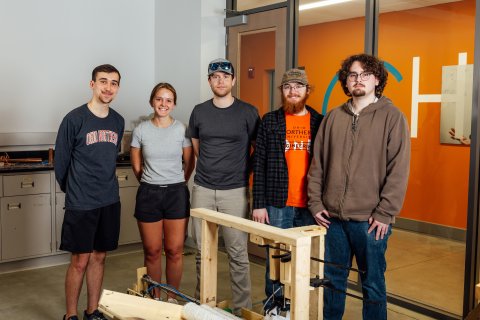
The ONU team is mentored by Dr. Ahmed Ammar, assistant professor of electrical and computer engineering, and James Rieman, BSME ’94, instructor of mechanical engineering, and includes students Ryan Nichols, Nykolis Cook, Hogan Ries, Elliott Powell, and Grace Lawson.
Representing the GPI clients are Kevin Jansen, BSME ’15, quality and continuous improvement manager, and Dr. Larry Funke, an ONU associate professor of mechanical engineering who is spending a sabbatical year working at GPI as a manufacturing engineer. GPI machine operators and maintenance staff who use the machines also provided insights.
Automating the process
The ONU team’s challenge is to help GPI improve the process of turning plastic-covered “sleeves” of 50 paper cups into individually-wrapped, single-use cups. Currently, the process is labor-intensive and prone to bottlenecks.
“There are a lot of fast-moving parts, and the paper cups get jammed pretty easily,” said Nichols. Because each operator manages two machines simultaneously, a single jam forces a production halt as they sprint between stations.
“We wanted to take it from a more manual process to a more automated process,” said Jansen, who worked closely with the student team over nine months. As an ONU alumnus, he sees the project as a vital way to give back to his alma mater while solving real-world efficiency issues.
The team’s goal is a machine capable of unpacking the plastic-covered sleeves of paper cups to be inserted into the single cup wrapping system. The design had to meet a rigorous set of requirements. It needed to have a footprint of under 7.5 by 3.5 feet; comply with OSHA requirements; be safe for the operators and easier to maintain. It also had to be capable of handling more than 150 cups per minute; maintain at least a 90% uptime; and limit damage to the cups to meet GPI’s quality standards. If replacement parts were needed, the client wanted to use parts that were readily available off the shelf, rather than custom parts.
Adapting to client needs
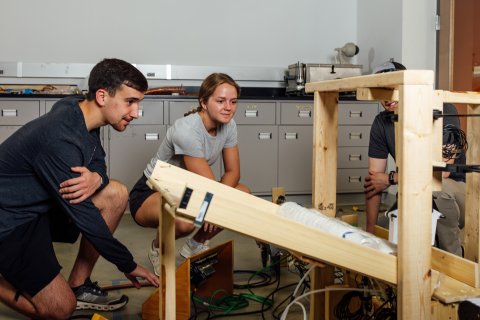
The ONU team has been working on the product since the fall semester, and will be making their final capstone presentation at ONU on April 1, then presenting the final prototype to the clients early in April.
Adapting to feedback was a core part of the process. For example, the team’s initial design included a hopper that held entire cases of cups to be loaded into the machine. But, when the client advised the team to focus more on the critical process of splitting the plastic sleeves, they simplified the design to use a ramp system that was more cost-efficient. GPI also suggested building and testing the product in segments rather than trying to build the entire product at one time.
Cost was also a concern. So, the team innovated. They prioritized gathering parts that GPI and Ohio Northern already had, and they used 3-D printing to build some parts.
Jansen sees the 3-D printing as vital in this project and future projects since students can build and test prototypes in a shorter period of time at virtually no cost. “It’s amazing what you can do —take an idea and turn it into an actual product very quickly,” he said. He was impressed with the electrical and programming setup and commended the team on their resourcefulness.
Learning in the real world
While the project is still a work in progress, the students found the experience valuable.
“I really wanted to work with an external client,” said Lawson. “I was excited about working on a project that would continue even after we had graduated.”
The challenges that came up were part of the learning experience. “I have definitely learned that testing is extremely important,” added Lawson. “We’ve had a lot of ideas that worked theoretically in our heads, but when we actually tested them, they didn’t work out.”
Working with teammates who brought a variety of backgrounds—mechanical engineering, computer engineering, electrical engineering—was definitely helpful, according to the students.
“Having that diverse set of perspectives and ideas has helped carry this project a lot further than we would have been able to do otherwise,” said Ries.