
To honor the legacy of Dr. Forrest Clingerman, an internationally respected professor of religion and philosophy and director of the Honors Program at Ohio Northern University, a unique Honors course was offered this fall, over a year after his unexpected death in the spring of 2024.
Designed by his close friend and colleague, Dr. Ray Person, professor of religion, the course, “Clingerman on Environmental Studies,” served as both a learning experience and a vital part of the grieving process for Person and the students.
“Forrest and I were close colleagues and friends,” said Person. “He was an amazing scholar as well as an exceptional teacher. And the fact that he was director of the Honors Program, I just put all those things together.”
All but three of the 14 students in the course had previously taken classes with Clingerman.
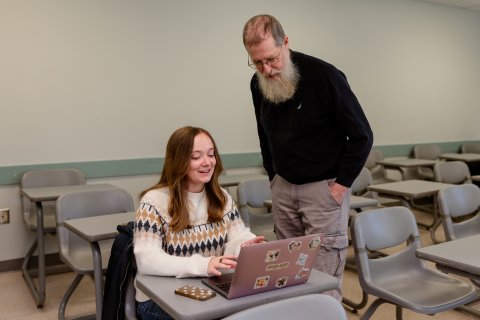
When the class discussed what Clingerman would think about a topic they were reading about, said Person, “he was in the room with us more than in most academic classes.”
The Honors course focused on Clingerman’s publications in environmental humanities. Key topics included: the relationship between the arts, religion, and the environment; the ethics of climate engineering; reflections on the Anthropocene (the period in which humans have influenced climate); and environmental hermeneutics.
Person described environmental hermeneutics as the “process of interpretation.” This approach is crucial for tackling “wicked problems,” issues that are so complex they require input from many different disciplines. It’s a promising way to mediate conflicting interpretations of a problem, allowing experts to the move forward with intentionality.
Clingerman’s research and writing looked at these issues not just in the context of the human community, but the natural community, according to Person. Clingerman was often the only theologian among scientists at environmental conferences.
“What Forrest does in his work so well is that he shows there are religious assumptions or narratives behind our interpretations of nature and climate,” said Person.
Clingerman showed how scientists talking about climate change in a very secular way, for example, may be influenced by religious assumptions, according to Person. A scientist’s argument against geoengineering might be similar to how the biblical Tower of Babel story demonstrates people’s inability to work together. Or a scientist’s argument for geoengineering might be similar to a different theological perspective like that of Pelagius, a fourth-century monk and theologian.
“So you can see even debates among scientists about deeply scientific things, nevertheless kind of reflect these competing religious stories,” said Person.
Clingerman had a world-wide reputation in the field and was often invited to international conferences, according to Person. “He had a broad reach.”
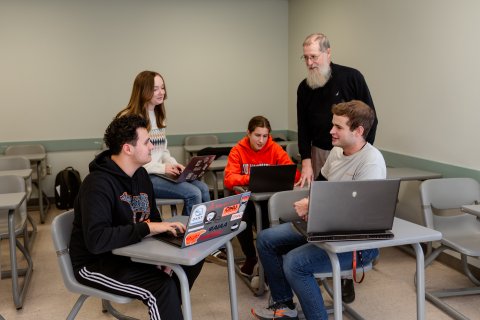
A number of academic journals published memorial tributes to Clingerman after his death, including a special issue of Environmental Philosophy that came out in the fall. Person has worked to fine tune several of Clingerman’s articles for future publication, tweaking and adding footnotes. “As a colleague who knew his work well, and since I’m working through it now, I’ve been overseeing the pre-publication of three or four works by Forrest.”
In the fall semester Honors course, students worked in teams to study how Clingerman’s work has impacted other scholars. Visiting experts also shared their expertise.
The students in the class came from a variety of disciplines, according to Person. Studying Clingerman’s scholarship offered them an opportunity to reflect on how his approach impacted their own fields.
Aaron Hess, a senior majoring in mechanical engineering, said the course opened his eyes to a multidisciplinary approach to geoengineering, sustainable development, and climate change.
“We looked at religion and philosophy and how that’s translated over into our own disciplines,” he said. Clingerman’s work in mediating different perspectives, he explained, can help engineers view the positives and negatives of a design and see that no one solution is the answer. “It’s not that one is good and another is bad, maybe both can be valid.”
Engineering tends to focus on mathematics, he added, but Clingerman’s work helps engineers think more about different factors, like culture and environment, that might affect projects, Hess said.
“One of the things I really liked about the course,” he added, “is that it was dialogue based. We read passages and we thought about them, but then we had conversations as people coming from different backgrounds and perspectives. The class was a model of that way of thinking.”
Evelyn (Evie) Megery, a senior who is double majoring in writing & multimedia studies and communication studies, took the Honors class because Clingerman had played a pivotal role in her college journey, she said.
As a communicator, she said, “telling stories is at the heart of what I do. Dr. Clingerman’s work has opened me up to a whole new perspective on how humans interact with the world around us. Ultimately, the complex and thoughtfully composed work he published throughout his career has inspired me to use my passion for writing to prompt reflection and meaningful dialogue.”