
An art professor’s journey through Italy has inspired a unique creative challenge at Ohio Northern University. In the Visual Literacy classroom, students are dreaming up their own 21st century “utopia,” using five historic Italian towns as a launchpad for their own visions.
Dr. Emily Jay, BFA ’10, assistant professor of art and ONU alumna, describes the project as an exercise in imagination and hope. “My biggest goal for this project—as corny as it sounds— is to give students the ability to dream of a better future,” she said.
Jay’s own trajectory was shaped by her ONU experience. In particular, a study abroad in Florence, Italy, ignited her lifelong “obsession” with Italian art and culture.
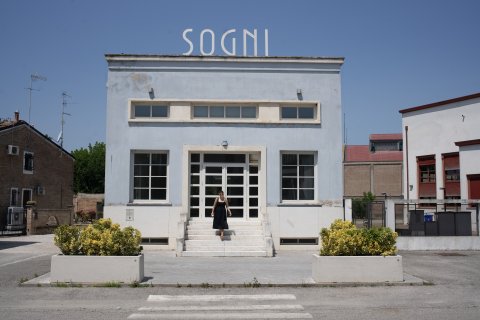
She’s returned to Italy many times since her undergraduate days, most recently this past summer with her husband, Ian Breidenbach. Together, they explored five Italian villages: Ivrea, Tresigallo, Pienza, San Leucio, and Nuova Gibelliana, each designed to be a utopia, or in Renaissance parlance, the “Ideal City.”
The trip not only yielded several scholarly achievements for Jay, including a book chapter, it reignited her commitment to using artistic exploration as a classroom tool.
“In teaching this course over the years, students tell me how overstimulated they feel in today’s digital environment and how addicted they are to their phones,” she said. “And often times, there was a feeling of despair I would sense from them.”
The creation of art, she explains, serves as a tactile antidote to visual overload. It offers a way to reclaim focus in a world of constant distraction.
“You learn differently when you are making a creative project,” she said. “Whether you are considered an artist or not, whether you have talent or not, that doesn’t interest me. What matters is the act of creation.”
Embarking on an Italian adventure
Supported by the Getty College of Arts & Sciences, Jay traveled to Italy in summer 2025 and spent a few weeks exploring the five Italian “utopias,” each created in different eras by unique visionaries. Curious about how people experience space, she journaled her impressions with notes, photographs, and sound recordings.
“A utopia is meant to be place where everything is working, where people are taken care of, where everything is perfect,” she said. “But, of course, perfection is subjective.”
From the 15th century Pienza, built by Pope Pius II, to the 20th century metaphysical utopia Tresigallo, built by the fascist Edmondo Rossini in the 1930s, Jay found it fascinating to see how people across the ages envisioned “living well.”
“The story of Tresigallo tickles me,” she said, noting this town was her favorite. “Mussolini made Rossini his Minister of Agriculture, and Rossini returns home and (without Mussolini’s awareness) funnels all the fascist government’s money into making his hometown a utopia.”
Tresigallo’s rationalist architecture, bright colors, and abundant plantings, exude a “weird and magical” vibe, she said.
While she absorbed the sensory details, Jay was also intrigued by how each town has adapted over time and functions today. “Each is a failed experiment because it’s not possible to achieve a utopia,” she said. “Yet people are still living in these spaces.”
From research to classroom
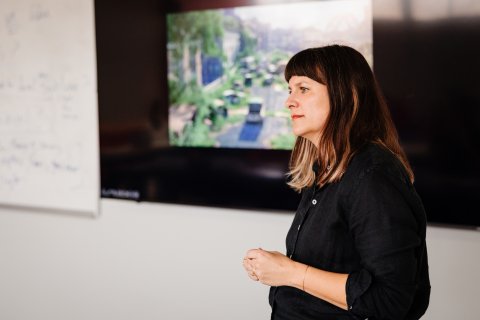
Returning to the U.S., Jay translated her research into a book chapter and a poem, both accepted for publication, an art exhibition, and conference presentations. However, she considers the “Illustrating Utopia” class project her biggest triumph.
Her Visual Literacy course, with sections offered in both fall and spring semesters, is intended to equip students with the skills needed to navigate today’s visual landscape. From the Renaissance to modern day, students explore the different ways that theorists and artists have made sense of the world.
For the final course project this fall, she tasked students with imagining their own “utopia,” complete with defined values and a vision board with materials, colors, and textures. With no set parameters, students used everything from video games to sketches to bring their visions to life.
Despite the diverse mediums, two factors remained consistent across the projects, providing valuable insights into what’s important to the next generation: sustainability and community.
“It was fascinating to see how students prioritized nature and community gathering spaces, from music centers to parks to bowling alleys,” Jay said.
Riley Ibaugh, a senior majoring in environmental and field biology, drew upon his knowledge of tribal cultures to design a society where people live in old-growth trees and animals provide public transportation.
“The specific evolutionary traits of each animal were used in my society, and it was sustainable and self-governing,” he said.
For Riley, who plans to become a park ranger, the project was also a lesson in human connection.
“Creation of any kind is a huge part of existing as a human,” he said. “And seeing the creations of others can connect us closer than any words can.”
Because students reported that they loved the assignment, Jay plans to make it a part of future Visual Literacy courses.
“Ultimately, I think it was a really hopeful experience for them,” she said.