
Dr. Bryan Lutz teaches students in his first-year Writing Seminar at Ohio Northern University a skill just as vital as grammar and syntax: how to be a critical consumer of media.
Whether you call it misinformation, disinformation, or “fake news,” much of the content flooding online spaces lacks even a shred of journalistic integrity, said Lutz, associate professor of rhetoric and composition.
“I am trying to teach academic writing, but the online space is saturated with lies that are community-driven and self-interested,” he says. “How can a student know what is real and what is fake and all the shades in-between?”
For Lutz, giving students the tools to evaluate the origin and veracity of on-line content is a core objective. He believes it is not sufficient to simply tell students which sources to trust; they must understand the strategies behind the deception.
“If we want them to combat misinformation and become effective writers and discerning citizens, we need them to be able to understand how people are trying to deceive them,” he said. “That’s much more powerful.”
From yellow journalism to digital sophistry
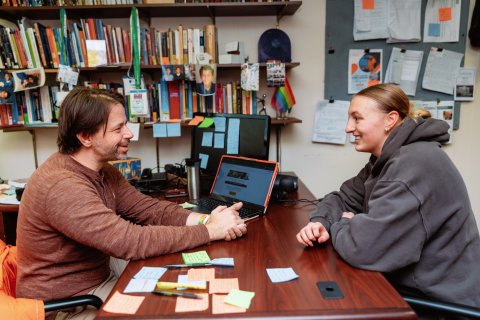
Lutz, an expert in organizational communication, activism, and advocacy, teaches courses in technical and scientific writing, gender and sexuality, and leads the Aurora web practicum, ONU’s undergraduate research journal.
In recent years, his research has focused on “fake news,” a phenomenon that he views as a defining issue of our times. He notes that Artificial Intelligence (AI) is now amplifying the threat, making it easier for bad actors to spread sophisticated “deep fake” videos and photographs.
In 2018, Lutz authored a chapter “Digital Sophistry: Trump, Twitter, and Teaching Fake News” in the book “President Donald Trump and his Political Discourse.” His research explored the parallels between the yellow journalism of the late 19th century and modern digital misinformation. In particular, he dissected the “Pizzagate” conspiracy theory, tracing its evolution from a single tweet by a white supremacist, to a dangerous narrative fueled by users on Reddit and 4chan, to an ultimate money-making venture.
“Somebody makes up a random lie, a network of actors try to make it into a story, and bad faith actors try to make money off of it,” said Lutz.
What makes today’s environment distinct is the lack of disincentives for spreading falsehoods, he noted. Additionally, algorithms amplify disinformation and play on people’s prejudices.
“People having disagreements, people making bad faith arguments, people who outright lie or fabricate information—that’s not new,” he said. “But what is new is that social media, for better or worse, has bypassed any kind of editorial gatekeeping or any kind of increased cost, such as printing and distributing, associated with it.”
Reverse engineering the truth
Lutz brings a unique technical edge to this teaching. While earning his Ph.D. at Iowa State University, he became proficient in computer science and web development. Now, he transfers those skills to his ONU students.
“It’s possible to reverse engineer the path of online content to find out where it originated and on what platforms it’s been shared,” he said. By teaching his students to trace digital breadcrumbs, he empowers them to make their own conclusions about a source’s legitimacy.
Beyond technical know-how, Lutz teaches students to scrutinize the language of the stories themselves. He warns that when a post uses “marginalizing forces,” like gender identity, race, or political affiliation, it’s a significant red flag.
Language as empowerment
As a rhetorician, Lutz is keenly aware that language is power. If he can help his student understand how and why that power is wielded, he considers his mission a success.
“There’s a cacophony of both good and bad faith actors trying to tell you what to think, what you should care about, who you should vote for, and what you should buy,” he explains. “Rhetoric and media are their primary tools to gain influence over your mind. By becoming a critical consumer and user of technology, you can become a smarter consumer and voter, a better thinker, and ultimately, a better person.”