
Parents and relatives, prepare yourselves: if your student is enrolled in Dr. Ron Peterson’s Chemistry of Food course this fall at Ohio Northern University, they just may dominate the conversation around the Thanksgiving table.
These non-science majors aren’t just passing a general education requirement, they’re unraveling the metabolic processes that make turkey meat white or dark and the cellular reactions that turn raw cranberries into sauce.
And, they are completely hooked.
Peterson still chuckles recalling the student who returned after break one year to share his family’s exasperated plea: “Stop telling us what’s happening on a molecular level— just enjoy the dinner!”
The course’s connection of rigorous science with everyday foods explains why there is a waitlist of students wanting to take the course every semester.
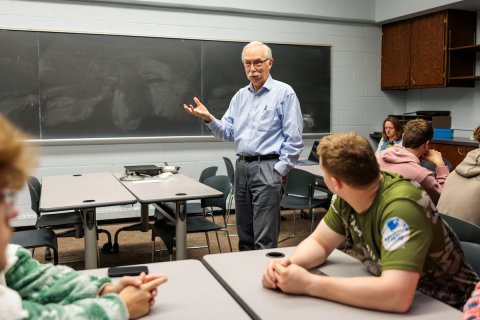
“Right away, we go from those basic chemical principles to something that they can observe and relate to in the real world,” says Peterson, professor of biochemistry.
“It’s such a fun class,” says Malaya McBrien, a psychology major. “I never realized such complexity existed behind the foods we make and eat.”
From home brews to higher ed
An accomplished home brewer, Peterson says that his foray into making his own craft beers years ago led to the realization that “it’s all biochemistry.” He so enjoyed the practical application of his science background that it inspired him to design the Chemistry of Food curriculum.
The course draws upon the modernist cuisine movement, which applies scientific principles to how food is prepared. Until around the mid-1980s, cooking was considered intuitive—an art rather than a science, Peterson explains. “You would experiment in the kitchen and note that something worked or didn’t work, but not understand why.”
Food writers like Harold McGee, who in 1984 authored the seminal “On Food and Cooking: The Science and Lore of the Kitchen,” changed the mindset. Today, many chefs realize that an understanding of the scientific mechanisms at play can improve their craft.
Peterson hopes this course sparks in students a scientific curiosity that will continue throughout their lives. “I want them to think about food and cooking differently from when they started the course,” he says.
Learning by doing
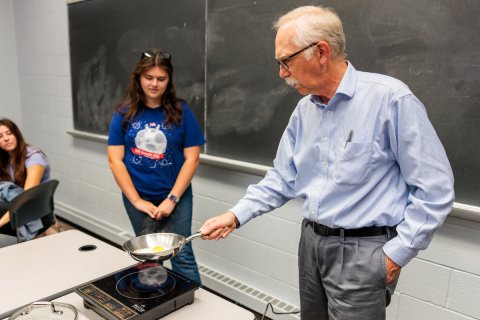
Whether their major is musical theatre or construction management, students must quickly leap from baseline chemistry to more complex concepts like non-covalent interactions. Fortunately, the course relies heavily on learning by doing.
Students explore pH and acidity by testing everyday staples like milk, yogurt, and sour cream. They uncover the metabolic processes that transform muscle into meat, turning it white or dark, tender or tough. And by chewing cherry gumdrops with their noses pinched, they experience firsthand how taste and aroma unite to create flavor.
What they find most surprising, according to Peterson, is that the red juice that seeps from cuts of meat isn’t blood. “It’s a solution called myoglobin, which is a soluble protein in the cells,” he explains.
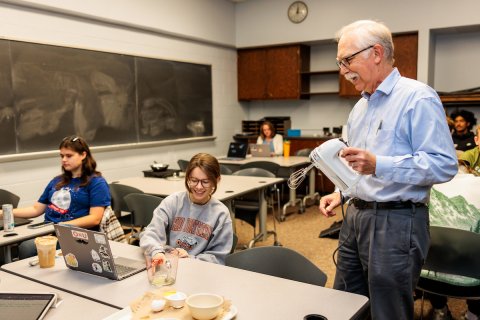
For the final course project, students devise a scientific hypothesis, conduct an experiment, and present the results to class.
With unlimited culinary options, “chocolate chip cookies and brownies are always the favorites,” says Peterson. “But they have to narrow it down to one variable, such as baking time, butter vs. margarine, white vs. brown sugar.”
While the end results can sometimes be subjective, students learn firsthand about the scientific method, variable isolation, and controlled experiments.
Passing the baton
Peterson will be retiring this summer after a distinguished 40-year career at ONU, passing the course’s baton to his colleague, Dr. Amelia Anderson-Wile, professor of chemistry. She is sitting in with the class this semester in preparation for taking over in the future.
“This is a challenging course to teach because it incorporates concepts from general, organic, and biochemistry,” Anderson-Wile says. “It’s been impressive to see how Dr. Peterson has built a series of interactive learning assignments that focus on the key concepts without overwhelming the students with too much information.”
In retirement, Peterson is looking forward to new adventures, including visiting Yellowstone National Park in the fall, confident that the course will be in good hands.
For her part, Anderson-Wile is grateful for his dedication to creating a course that resonates with students. Looking ahead, she hopes to perhaps expand upon the course by adding a study abroad component.
“Dr. Peterson has put a lot of effort into developing a whole course around food,” she says. “It takes a special educator to recognize what registers with non-majors and run with it.”