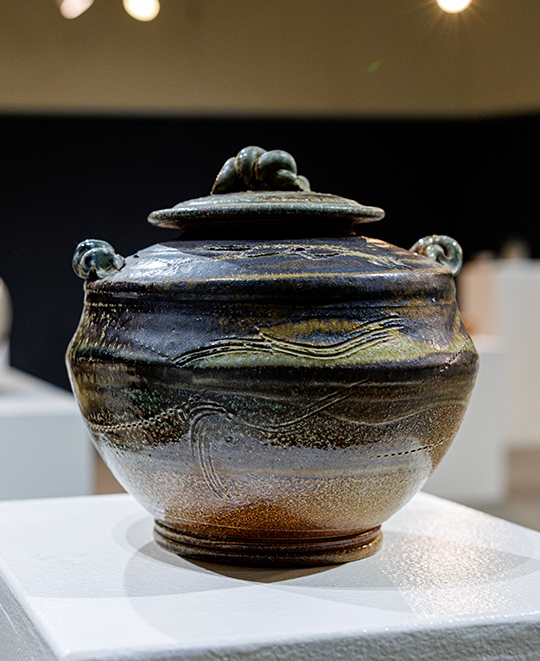
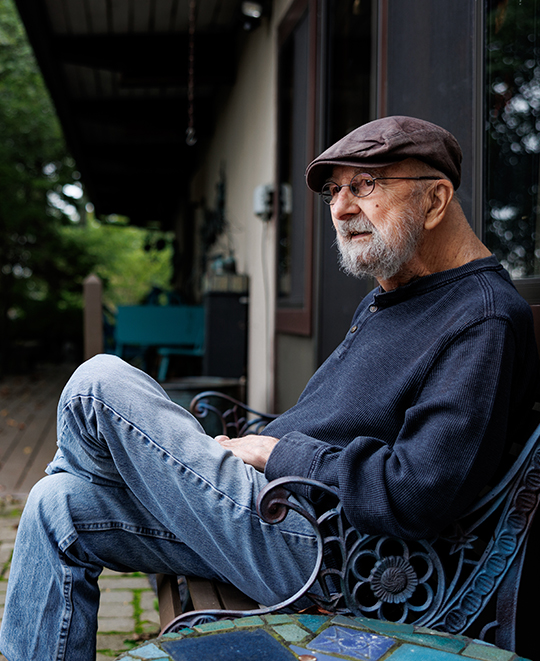
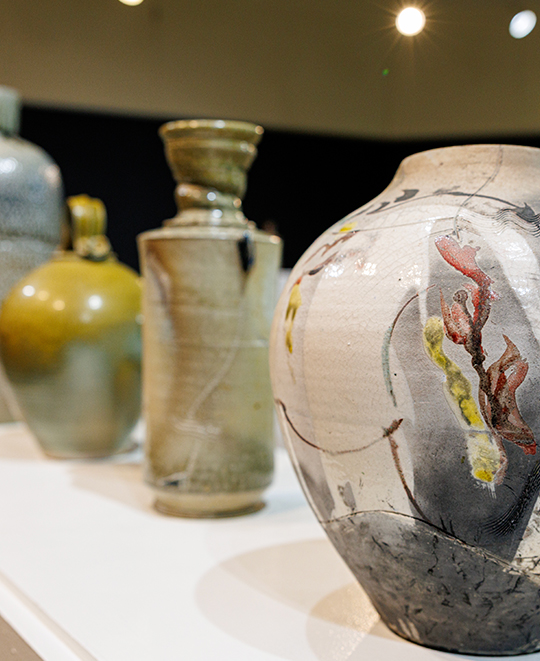
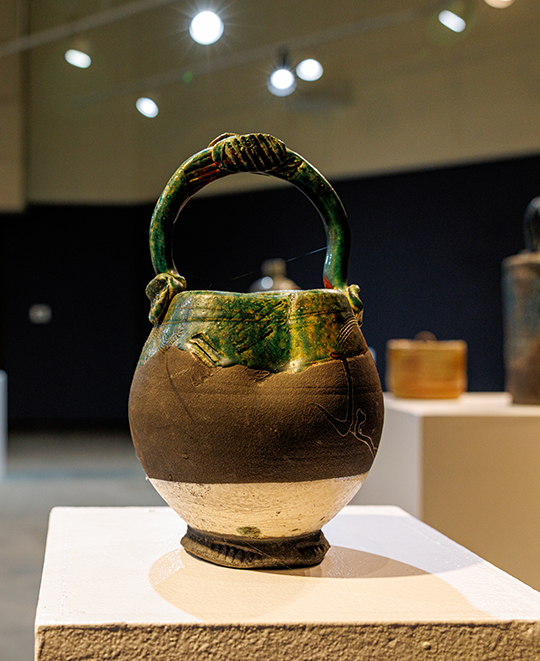
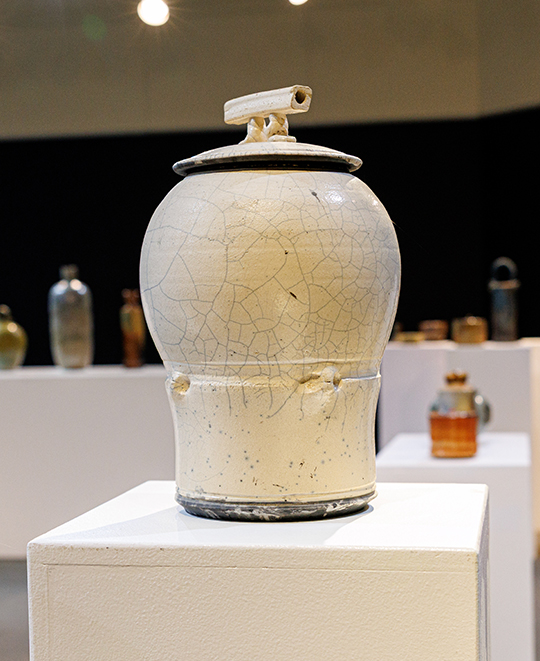
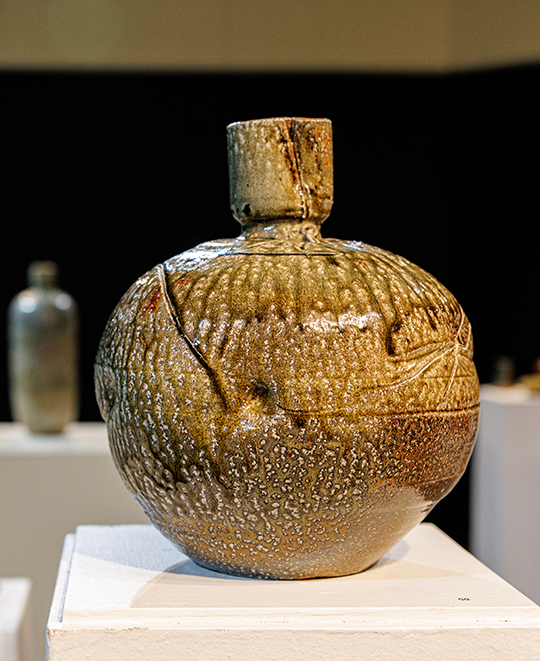
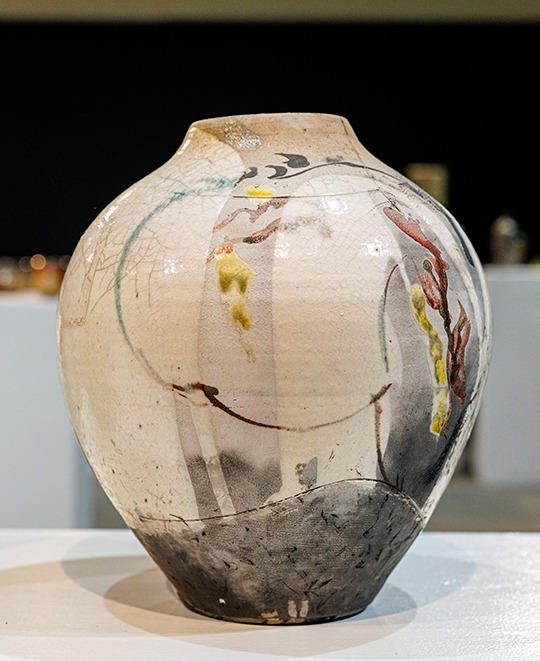
Fifty-one exquisite ceramic pieces crafted by Professor of Art Emeritus Bruce Chesser are currently on display at Ohio Northern University’s Elzay Gallery of Art through September 26.
While the exhibition serves as a retrospective of his artistry during his three decades at ONU, it omits what Chesser considers his true masterpiece: his students.
“The pieces in the gallery are what I made during my teaching career, but if I could have an exhibition of what I did, that gallery would be full of students,” he says. “That was my number one focus— the students were most important.”
Former students and art enthusiasts alike are invited to celebrate Chesser’s legacy at an artist reception during Homecoming & Reunion Weekend on Saturday, September 26, 2026, from 9 a.m. to noon. The reception marks the close of the exhibition.
From 1970 to 2002, Chesser taught courses in ceramics, sculpture, drawing, and art history at ONU. With his gentle, encouraging nature, he inspired students from all majors to view art as essential to the human experience.
“I don’t think we could live without it,” he says. “The human spirit demands that you sing, you dance, you create.”
Growing up in a working-class family, Chesser was unaware that people could pursue art as a career. He enrolled at Ohio University (OU) to become a teacher, mainly to “avoid the factory.”
Once at OU, he signed up for an art class and found his calling. “The art department felt like home. I even liked how it smelled,” he laughs. “I thought, “Well, this is what I want to do.’”
Chesser obtained both a bachelor’s and master’s degree in fine arts at OU. As an undergraduate, he took his first ceramics course, discovering the medium that matched his artistic energy.
“I wasn’t good at sitting for long hours, and ceramics was physical with lots of moving around and hauling bags of clay,” he says. “I was also good at it. When you find things that you’re good at, you keep doing them.”
He specializes in the contemporary interpretation of traditional functional ceramics, including vessels and vases.
“I create functional pieces that can be used in a kitchen or home—that’s been my boundary,” he says. “But within that boundary, I create interest in the surface and the form. I want there to be something about my pieces that invites you to examine them a bit closer. Each time you pick them up, I want you see something you haven’t seen before.”
Over the decades, he has experimented with and refined his preferred techniques--Raku and salt glazing, two well-known processes that rely on extreme temperature dynamics and atmospheric reactions to create one-of-a-kind, unpredictable surfaces. His work has been part of more than 100 juried, invitational, and one-person arts shows.
The 51 pieces on display in the Elzay Gallery are on loan from colleagues, former students, family, and friends. Although Chesser doesn’t date his pieces, he remembers all but one in the retrospective, noting that the exhibition highlights the evolution of his work. Each piece was meticulously crafted during his 32 years at ONU, where he found equal joy in the studio and the classroom.
Chesser taught many students who went on to become artists or art educators themselves, including ceramic artist Luke Sheets, BFA ’95, professor of art and director of ONU’s School of Arts, Humanities, and Social Sciences in the Getty College of Arts & Sciences.
“I loved seeing the students grow and become adults,” Chesser says. “For me, it was not about teaching them ceramics, but about making them better people.”
He sought to instill in each student an appreciation for the arts. Some of his favorite moments came when former students would eagerly reach out to share that they’d visited an art museum and seen in person the masterpieces they’d studied in class. Above all, his hope for every student was that they would find a career they could be excited about.
“If you love your work, that’s what it is about,” he says. “I’ve always said I never worked a day in my life.”
Now in his eighth decade, Chesser is still actively creating ceramic pieces in his home studio. Ceramics is an art form that dates back nearly 30,000 years, providing vital clues in the study of human development. With each piece Chesser crafts, he is leaving behind an artifact of this time and place. Like his teaching, it’s a legacy built to last.
“Someone may find one of my pieces someday and wonder, ‘Who made this? What did they use it for?’” he says. “My work is going to be around forever.”