
Several formative life experiences turned Dr. Stacey Lowery Bretz into a passionate advocate for education. A combination of natural curiosity and mentors who believed in her, and opened doors, ultimately led her to become an internationally recognized expert in chemistry education.
Now, as dean of Ohio Northern University’s Getty College of Arts & Sciences, Bretz is empowering others to learn, teach, and lead. Thanks to three recent distinguished appointments with the Ohio Academy of Science, the American Council on Education, and the American Chemical Society, she is expanding her reach even further.
Bretz says that while some people are superheroes, others are “hero support.” She places herself firmly in the latter category. Through these appointments, she’s eager to become an even stronger champion for others in the education sphere.
“To me, that’s what leadership is about, being of service to other people and making possible, to the extent I can, the amazing work they are doing,” she says. “As a first-generation college student, I wouldn’t be where I am today without people investing in me, so I feel a great responsibility to pay it forward.”
A full-circle appointment
Bretz’s two-year appointment to the Board of Trustees for the Ohio Academy of Science has a great backstory, she says. The organization not only led her to a chemistry career, but to true love.
Growing up in Sandusky, Ohio, Bretz was drawn to chemistry because it was the only subject she found challenging. Her high school teacher encouraged her to participate in the science fairs sponsored by the Ohio Academy of Science. Because Bretz was busy with extracurriculars, the teacher also enlisted an upperclassman, Richard Bretz, to prepare the solutions for her chemistry experiments during his study halls.
“He basically became my lab tech,” laughed Bretz. And years later, he became her husband.
During her junior year in high school, Bretz’s science fair entry won the award for the best chemistry project in the state of Ohio. As a result, the Ohio Academy of Science nominated her to represent Ohio as part of the American Junior Academy of Science and to present her research to the American Association for the Advancement of Science conference in Los Angeles.
“It was 1985 and I attended my first-ever science conference. It was also my first time on a plane,” said Bretz. “My seventeen-year-old self cannot even comprehend, really, that she’s at an international meeting with world-renowned scholars talking about the frontiers of science.”
The Ohio Academy of Science serves students of all ages and is the “leading organization in Ohio to foster curiosity, discovery, and innovation to unite all who value education, science, engineering, technology or their applications to benefit society.”
“To be elected to the board of an organization that set me on my path—it’s just a full-circle moment,” Bretz said.
Developing the next generation of leaders
This spring, Bretz also received a three-year appointment to the board for the Council of Fellows of the American Council on Education (ACE).
ACE is the major coordinating body for the 4,600-plus higher education institutions in the U.S., and its Council of Fellows develops the next generation of university leaders. Bretz participated in the esteemed ACE Fellow program while at Miami University (Ohio). The two-year mentorship program prepared her to assume the dean position at Ohio Northern, she says.
Getting a “peek under the hood” of university administration and governance motivated her to become a leader who clears obstacles and forges paths to high-impact teaching and learning, she added. As a board member for the ACE Council of Fellows, she hopes to help cultivate forward-thinking university leadership in an era of uncertainty.
Paying it forward
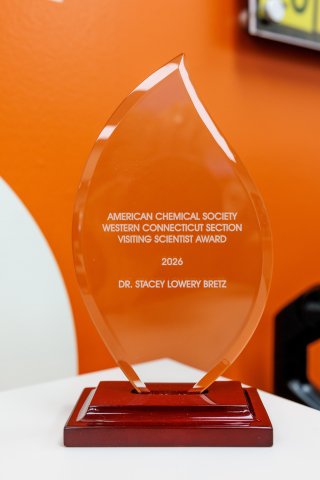
Bretz was also honored this spring to receive the Visiting Scholar Award from the Western Connecticut Section of the American Chemical Society. Since 1967, this award has recognized the extraordinary contributions of preeminent chemistry scholars.
In conjunction with the honor, Bretz spent a week in May engaging with high school chemistry teachers in Fairfield County, Connecticut, showing them strategies to enhance their teaching.
“My area of research is the interface of chemistry and cognitive psychology,” said Bretz. “In plain terms, I focus on how people teach and learn chemistry.”
Her interest began as a teaching assistant in graduate school, when she saw her students struggling to understand concepts. It prompted her to seek to “understand how the brain learns to reason with or develop concepts of things that are too small to see.”
Bretz has co-authored three chemistry textbooks that feature pedagogy developed from her research, including the first AP chemistry textbook to use an atom-focused approach. She has also authored more than 100 peer-reviewed articles and given more than 500 invited keynotes, seminars, and conference presentations on the topic of chemistry education.
As the visiting scholar in Connecticut, she notes it was a privilege to collaborate with high school teachers who are opening doors to chemistry for young students, just like her teacher from Perkins High School did for her.
“I think we all have a responsibility to pay forward opportunities that were made available for us,” she said. “I’m not saying it has to be one-for-one, it doesn’t have to be the exact same opportunity. But I have had a lot of privilege in my life, and I’ve been able to do a lot for my own children and my own family because other people chose to make benevolent investments in organizations. So now it’s an honor for me to do the same.”