
Aurora, Ohio Northern University’s open-access digital research journal, illuminates the original research projects produced by ONU undergraduates. Fittingly named after the Latin word for “dawn” or “to shine light,” the journal reaches a global audience.
“It’s a real chance for undergrads to show off their work,” says managing editor Jaylynn Brownlee, an English education major, adding that it boosts resumes and grad school applications.
The journal averages 200 downloads a month, according to Aurora advisor Dr. Bryan Lutz, associate professor of rhetoric and composition. “We are reaching folks not only in the U.S. and Canada, but also from India, China, South America, and Africa, including governmental agencies.”
ONU is known for providing extensive opportunities for undergraduate research. Some students assist faculty members with their grant-funded projects, which can lead to co-authored papers and opportunities to present at regional and national conferences. Others tackle individual projects, guided by faculty mentors, seeking answers to questions that capture their interest.
Aurora targets the latter category, explains Lutz. Acting as an extension of ONU’s undergraduate research activities, the journal publishes projects that advance knowledge for society’s betterment.
“There should always be an aspect of academic research that is for the public good. It’s not just for a class or a job, although that’s important too, but there’s an implication of actually improving lives and the well-being of the world, and that starts here,” Lutz says.
Behind the scenes
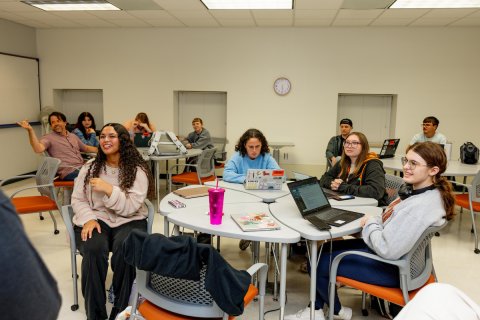
For Aurora’s student staff, producing the journal is a months-long endeavor that begins in the fall.
Students join the staff through a one-credit hour practicum course offered both fall and spring semesters, or by participating in the Aurora student organization. Two paid managing editor positions provide key leadership.
In the fall, staff members break into groups to focus on either the digital commons platform and HTML coding, or marketing initiatives, including calls for submissions and social media promotion. Additionally, all staff members work to build skills in editorial and publishing processes.
In the spring, ONU hosts its Student Research Colloquium, featuring more than 100 undergraduate research papers, projects, and posters. Aurora’s content primarily arises out of this research showcase, and the journal’s staff carefully reviews the abstracts and solicits promising projects.
“We solicit some works from a fall engineering research colloquium and from upper-level courses, but it’s all hands-on deck in the spring, and the Aurora staff has been trained to hit the ground running,” says Lutz.
High standards and clear communication
To be considered for publication, a research project must meet an established rubric with clearly-defined metrics for hypothesis, methodology, and thesis, explains Lutz.
“All academic research answers a question—there’s some kind of unknown we need to pursue.”
Regardless of the discipline, “what unites us is that we all have a common approach,” he adds.
“It’s not just going around the internet and cherry picking the information that we think confirms our bias or point of view,” he says. “There’s an approach and quantitative or qualitative data.”
The Aurora staff does not evaluate the research methodology or outcomes, however, leaving that to each project’s faculty advisor. Instead, the staff ensures the writing is clear and purposeful.
“We are focused on the writing. Is the author clearly explaining things?” Lutz says.
“We provide good, solid feedback so that students can revise their projects and make it the strongest it could possibly be before it’s available to the world.”
Elevating student voices
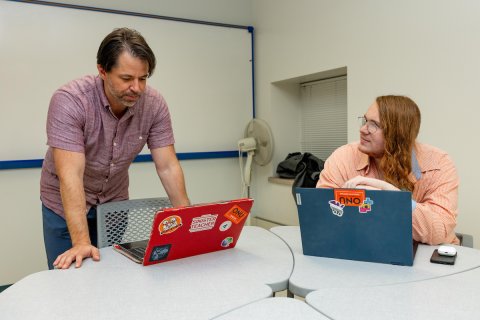
As Aurora continues its annual publication cycle, Lutz is pleased with the journal’s evolution, especially how staff members have become a campus voice for elevating academic research.
Victoria Holbrook-Phillips, managing editor and English education major, shares that staff produces a “Northern Lights” social media series. “We interview undergraduate researchers and highlight both the researcher and their findings,” she says. “We also create our Prove It! Posts, in which we use research and evidence to address questions and challenge common misconceptions.”
For the Aurora staff, producing a quality academic journal is an invaluable learning experience.
“My time with Aurora has allowed me to develop essential professional competencies, including effective team delegation, collaborative leadership, and the ability to critically analyze and evaluate academic research structures,” says Brownlee.
“I’ve gained skills through Aurora that I know will carry directly into my future classroom,” adds Holbrook-Phillips. “I’ve simply become a stronger editor with a deeper understanding of grammar, mechanics, and the many decisions that shape effective writing. More importantly, I’ve learned how to approach feedback as an opportunity for growth.”