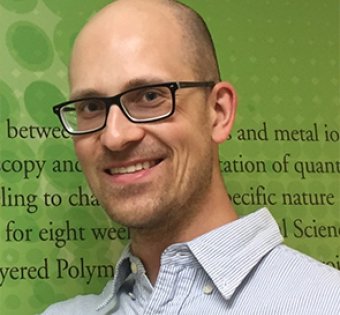
Eric Schultz, BS ’11, Ph.D. was interviewed by Julia Derrer, an Honors student majoring in forensic biology.
Most people don’t expect plant science to involve zero gravity, hyperspectral imaging, or space exploration, but for Eric Schultz, that’s exactly where curiosity has taken him.
Eric is an Ohio Northern University Honors graduate, who came to ONU because he wanted a small campus with strong academics and a close-knit community. As a biology major on the plant track, he found an environment that encouraged him to explore his interests both inside and outside the classroom.
Through the Honors Program, Eric formed some of his closest friendships and took classes that pushed him to think differently, including courses far outside his major. While at ONU, he gained valuable research experience through internships at Cornell and Harvard, where he focused on botany. These opportunities helped confirm his passion for plant biology and prepared him for graduate study.
After graduating, he attended the University of Florida, where he worked on research in collaboration with NASA aboard parabolic aircraft. By studying how plants respond to zero gravity, Eric contributed to research that helps prepare for future human space exploration.
Eric later conducted his postdoctoral research at both the University of Florida and Washington University in St. Louis. He researched how transmembrane proteins convert physical forces—specifically gravity-induced membrane tension—into chemical signals that allow plants to sense their orientation and direct their growth. Characterizing how plants grow eventually led him to his current role at Corteva Agriscience, where he now works as a principal investigator and decision scientist.
Since 2017, Eric has been leading a crop phenotype team that tests new plant products in controlled environments and early-stage field trials. Using imaging and statistics, his team analyzes when plants grow differently from expected, and what those differences might mean. They use tools like hyperspectral imaging to help answer questions such as, “Are the plants doing what they’re supposed to do?” and “Are they healthy?”
One example of this work involves gene editing corn so it can use nitrogen from the air as fertilizer—something soybean plants already do. If successful, this could reduce greenhouse gas emissions in corn production by up to 75 percent. Overall, Eric’s research focuses on finding more efficient ways to produce food for a growing global population and helping address issues like hunger and famine.

When asked what changes/developments he could see in the future of the field, he stated that AI is going to be big. Already, AI is replacing both technical and non-technical jobs, and changing the way research is done.
During the discussion, it is clear that the Honors Program helped give Eric the freedom to explore his interests, form meaningful connections, and shape his own path. When asked about his biggest key to success, Eric replied that imagination is the biggest one, because with imagination comes curiosity and innovation. He shared that, as students, we need a willingness to fail because that’s how we learn, discover new things, and pursue new and interesting paths.