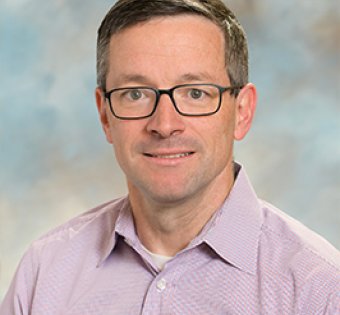
Ohio Northern University alumnus Kevin Haynes, PharmD '01, works to keep patients safe around the world. As director of epidemiology for Johnson & Johnson Innovative Medicine, he helps make sure the drugs patients take are safe and that they work.
"What that means," he explained, "is that I participate in the conduct of drug safety studies for our immunology products such as Tremfya and Remicade." Those drugs treat autoimmune conditions like inflammatory bowel disease, psoriasis, and psoriatic arthritis.
Haynes works in pharmacoepidemiology, a field that joins pharmacy and epidemiology. The field explores how often drugs cause side effects and how widespread those effects are in populations.
In his work, Haynes studies huge datasets built from insurance company medical and pharmacy claims. He uses them to track drug side effects, prepare warning labels, and give doctors and patients the information they need to weigh a drug's risks against its benefits. "My work has led to labeling changes to inform patients on the safety aspects of our immunology products," he said.
Drugs are tested in trials before they are approved. But rare side effects may not show up in those early trials. By studying the anonymous medical records of hundreds of thousands of people, pharmacoepidemiologists can see how a drug works in the real world and catch these rare problems.
One well-known example, Haynes said, was Vioxx. The arthritis drug was widely prescribed. After the public began using it, pharmacoepidemiologists learned it raised the risk of heart attacks, strokes, and other heart problems.
Over his career, Haynes has authored more than 160 peer-reviewed papers and worked on several major studies. Earlier in his career, he was part of the FDA Sentinel Initiative, which studied medical products using a common data model across several large health insurers. He helped set up the studies that tracked side effects of the COVID-19 vaccines. He also took part in patient-centered research on the best dose of aspirin for treating heart disease.
Along with his work at Johnson & Johnson, Haynes is an adjunct assistant professor of epidemiology at the Center for Clinical Epidemiology and Biostatistics at the University of Pennsylvania's Perelman School of Medicine. He is also a fellow of the International Society for Pharmacoepidemiology.
Haynes, who grew up in New Jersey, was drawn to pharmacy by his high school interest in chemistry and biology. He chose ONU, he said, because he wanted a small school focused on pharmacy that still gave him a taste of other fields like law, the humanities, and engineering.
After ONU, Haynes completed a two-year drug development fellowship at the University of North Carolina and GlaxoSmithKline (GSK) in North Carolina. "While on a project team working on a Phase 2 clinical trial," he said, "I met the epidemiologists at GSK and I was intrigued by the availability of real-world data already collected to address drug safety questions."
That experience led Haynes to the University of Pennsylvania, where he earned his M.S. in clinical epidemiology. There he was mentored by Brian Strom, a pioneer in the field who is now at Rutgers University, and by Sean Hennessy, his advisor.
ONU was key to his career, Haynes said. His work with Dr. Jon Sprague gave him a foundation in research. Dr. Jeff Allison mentored him and encouraged him to network at national meetings, "which exposed me to collaboration across the field."
Today, Haynes makes time to teach and mentor. He guides students and early-career researchers through the International Society for Pharmacoepidemiology, and he is always glad to talk with anyone in pharmacy or epidemiology who is thinking through their own career path.
Haynes met his wife at an ONU alumni event. Laura (Dickey) Haynes, PharmD '07, has built her own career in patient safety, healthcare quality and performance management at the University of Pennsylvania Health System, where she now works as a lead pharmacist in pharmacy auditing and regulatory compliance.
"ONU gave me a foundation and inspired me to become a lifelong learner across multiple disciplines," Haynes said.
(Summer 2026)