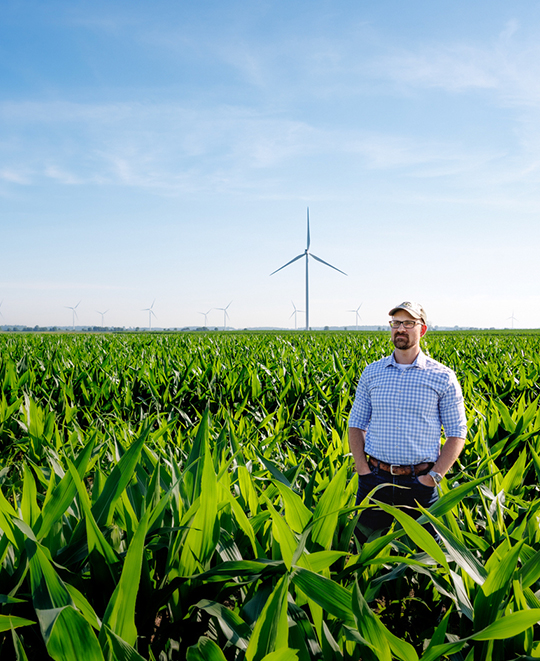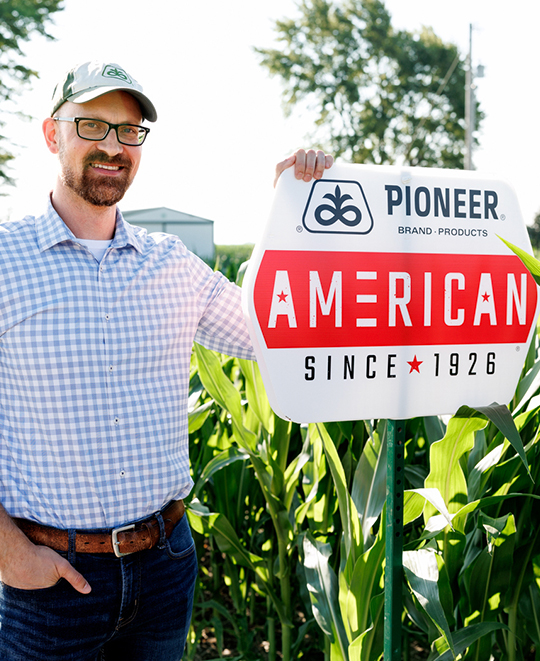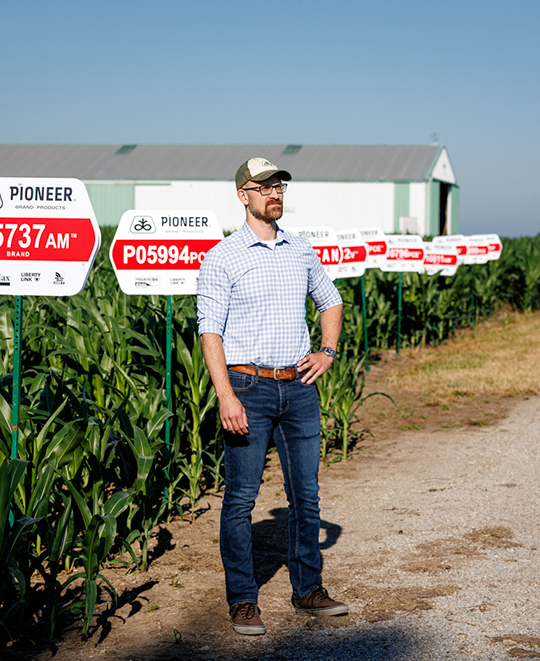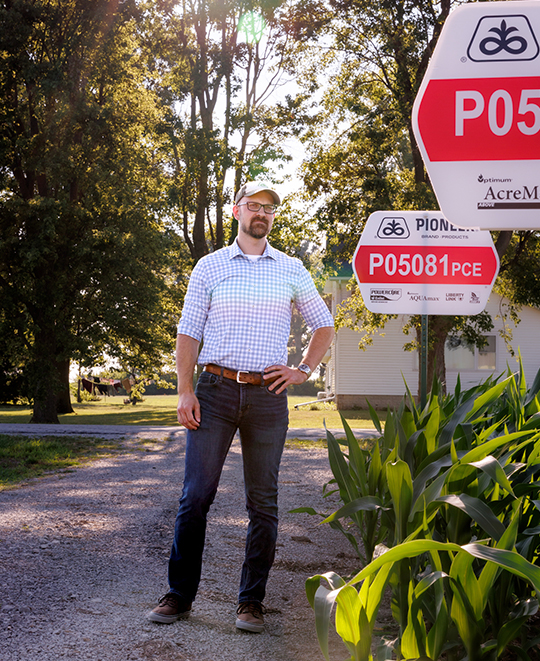
A future-focused plant researcher, Ohio Northern University alumnus Eric Schultz, BS ’11, Ph.D., leads a small team of scientists and engineers focused on improving the efficiency, quality, and safety of agricultural and food production systems.
Putting that in big picture terms: they’re tackling huge challenges like how to feed a growing global population and adapt to climate change.
Since 2017, Schultz has been a principal investigator at Corteva Agriscience in Johnston, Iowa, heading a crop phenotype team that tests new plant products in controlled environments and early-stage field trials.
His forward-thinking approach led to him receiving the 2024 North American Plant Phenotyping Network Industry Award. The award celebrates scientists or engineers making important contributions to plant phenotyping and allied disciplines. It recognizes individuals who demonstrate technical excellence, synergistic activities, and leadership.
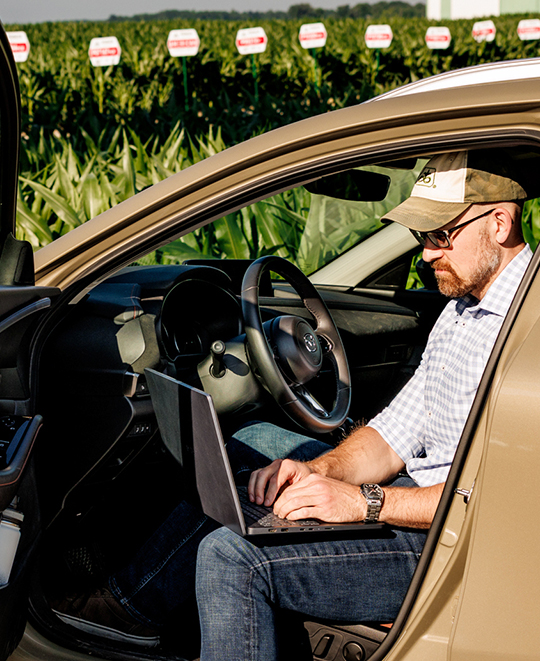
Schultz explains that his work is a combination of data science, statistics, agronomy, plant biology, molecular biology, engineering, programming, and professional communication. “Our main role is evaluating how plants perform using a variety of different tools, from hyperspectral cameras to protein quantification, and contextualizing those data to see which products should advance.”
Noting that being a scientist means being wrong 99 percent of the time, he is nonetheless driven by “curiosity and relentless discovery.”
“We ask questions all day and try to find answers,” he says. “And in the process of finding answers, we learn all sorts of different things.”
“Plant science gives us a lot of unique tools,” he adds. “We can make edits and engineer new variants to see what would happen if X happened to Y, and push the bounds of what’s known.”
While his lab research pushes those bounds, Schultz contextualizes his work as early in the R&D process. “The plants we interact with are for research only, and the products that may eventually come from our learnings won’t hit the market for 10-15 years, after thorough downstream testing and evaluation.”
Plants are his focus now, but animals were his first interest. He came to ONU to become a veterinarian but changed direction after Dr. Robert Verb’s lecture on cycads in Biology 123. “I just fell in love with the subject,” he says. “I’ve been plant-y ever since!”
He credits ONU for allowing him to deeply explore his interests and giving him a solid foundation for graduate school. While pursuing his undergraduate degree, he engaged in two summer internships, one with the Boyce-Thompson Institute at Cornell and one with Harvard, both in the plant field. In 2010, he attended a Botanical Society of America conference, where he networked and learned about a lab at the University of Florida (UF) researching plants in space, from which he ultimately obtained his Ph.D. in 2015. He later engaged in postdoctoral research at UF and Washington University in St. Louis, where he continued his work on how plants sense gravity and respond to microgravity environments. One highlight of these experiences was working on a team conducting experiments onboard the International Space Station.
Looking ahead, Schultz says automation is the future of agriculture. “AI is going to be big—it already is,” he says.
He’s keenly aware that his work is important. “As the population grows and farmland shrinks we’ll have to produce more food on less land with fewer resources. We can do all that, and in a way that’s better for the environment, at the same time.”
(Summer 2026)